A branding guide for a growing company starts with one correction: a brand is not a logo. It is the set of associations people hold about your company, what you stand for, how you sound, how you look and what it feels like to deal with you; branding is the deliberate work of shaping those associations so they win you the clients, people and partners you want. This guide covers strategy before design, the identity system, voice, roll-out, measurement, and four identities from our own work.
Last updated: 24 October 2026.
What is a brand, and what is it not?
The logo is a signature: important, and one part of a larger system. A brand is also not a slogan, a colour palette or a set of values printed on a wall. Those are outputs. The brand is what they add up to in other people’s heads, the sum of three things:
- Position: who you serve, what you offer and why you rather than an alternative.
- Identity: the visual and verbal system that makes you recognisable.
- Experience: every interaction, from the website to the invoice.
For a growing company the brand has a practical job. It shortens sales conversations, justifies a price, attracts people who want to work for you, and keeps a widening group of employees describing the company the same way.
Branding guide: the short version
Branding runs in a fixed order, and most of the trouble we see comes from taking it out of order. The whole of this guide fits in the table below.
| Stage | What is decided | Who decides |
|---|---|---|
| Strategy | Audience, position, proof, personality, name | Leadership, with the agency |
| Identity | Logo, type, colour, imagery, layout, motion | Designers, approved by leadership |
| Voice | Messages, principles, vocabulary, boilerplate | Marketing, with a writer |
| Roll-out | Inventory, priorities, templates, launch | A named owner inside the company |
| Measurement | Three or four signals, read at six and twelve months | The same owner |
Why does strategy come before design?
Brand strategy is the thinking that tells design what to do. Skipping it produces work that looks good in a presentation and means nothing in the market.
What to decide first
- Audience. Who do you most need to persuade, and what do they currently believe about your category?
- Position. The one territory you can credibly own: a specialism, a method, a point of view.
- Proof. The evidence that makes the position believable: the work, the people, the method.
- Personality. How the brand should feel: confident or warm, technical or plain, playful or restrained.
- Name. If you are starting out, the name belongs here, before any design, with trademark and domain checks; our guide to digital foundations for a start-up puts it in order.
Write the strategy down on one or two pages and have it signed off. Every design decision afterwards is judged against that page, not against taste, which ends the longest debates a company can have about a logo.
What to leave for later
Sub-brands for products you have not launched, detailed brand architecture for a company of fifteen people and elaborate manifestos can wait. A clear position and a usable identity will serve you for years.
Unsure whether you need new strategy or a refresh? Ask whether the business has changed what it offers or whom it serves. If yes, it is a rebrand and the strategy comes first. If no, it is a refresh.
What makes up an identity system?
An identity is a system, not a set of files. A complete one usually includes the elements below, each with rules for how it combines with the others.
| Element | What it does |
|---|---|
| Logo and marks | Signature and recognition in small spaces |
| Typography | Voice in visual form; a large share of how a brand feels |
| Colour | Recognition and hierarchy, with rules for contrast and accessibility |
| Imagery | Photography, illustration or 3D direction, with clear dos and don’ts |
| Layout and grid | How elements combine on screen and in print |
| Motion | How the brand moves on screens and in video |
| Applications | Website, social templates, presentations, stationery, signage |
Applications are where an identity proves itself. A system that only works on the presentation slide fails on a busy web page, a small social avatar and a document printed in black and white. Test it on those before you approve it.
The way an agency works changes the budget here. At Odduel the repetitive production of an identity (the website’s component library, social templates in every size, first drafts of the guidelines, image preparation, first-pass translations) is carried by AI, then reviewed and finished by a designer. The budget goes where the result is decided: strategy, the concept, art direction and the final craft. In our experience that is why an identity and its website are delivered in weeks rather than months, as full service from Barcelona and São Paulo.
How do you define voice and messaging?
How a brand speaks is as recognisable as how it looks. A defined voice gives everyone who writes for the company, from sales to support, a shared set of rules. A practical messaging framework includes:
- A positioning statement, internal, one or two sentences.
- Key messages for each audience, with proof points.
- Voice principles, each with a “this, not that” example.
- Vocabulary: words you use, words you avoid.
- Boilerplate: the standard description of the company in short and long forms.
Test the voice on real material: a home page, a job advert, an email declining a request. If it only works in a manifesto, it does not work. On the website the voice is written into the interface as much as the copy, which is why we treat UX and UI design as part of the brand.
How do you roll a brand out?
A new brand fails more often in roll-out than in design. Plan it as a project with a named owner:
- Inventory every place the brand appears: site, social profiles, documents, signage, email signatures, vehicles, packaging.
- Prioritise by visibility: website and social first, internal templates soon after, physical items as they are replaced.
- Brief the company before launch, so employees can explain the change in one sentence.
- Provide tools: templates, an asset library and brand guidelines that answer everyday questions without a designer present.
- Launch with intent: one moment, consistent everywhere visible, with a short explanation of why.
Brand and website are best done together: the site launches as the fullest expression of the brand, and the guidelines are tested on real pages before they are printed. Our guide to website development for a business explains how that project runs; what it costs is in how much does a website cost.
How do you measure a brand?
Brand is harder to measure than a campaign, but not impossible. Useful signals:
- Direct and branded search volume over time.
- Win rates and sales cycle length, before and after.
- Recruitment: number and quality of applicants.
- Recognition: short surveys asking your audience what they associate with you.
No single metric captures a brand. Choose three or four, measure them before the change, and review them after six and twelve months.
Four identities, four different jobs
An identity is a set of decisions that make many future decisions easier. Four projects from our own portfolio show it:
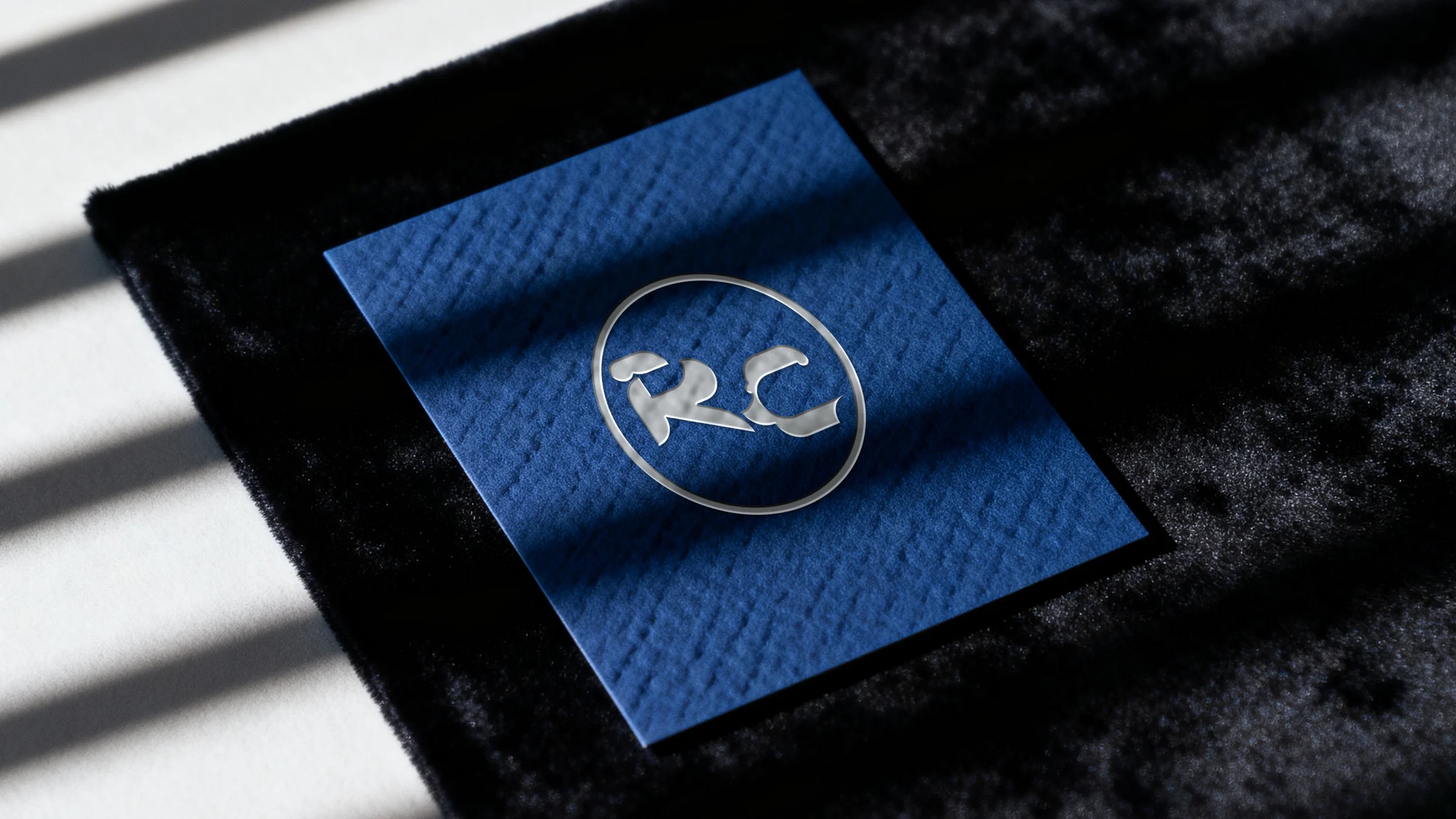
- Rainbow Conspiracy, an electronic music project in London that treats each release as a world of its own. The job was a common identity for those worlds: a wordmark, an icon, an alphabet, a colour rule built on the red, green and blue of a screen, and a guide that keeps anyone who designs for the project aligned with the artist’s vision.
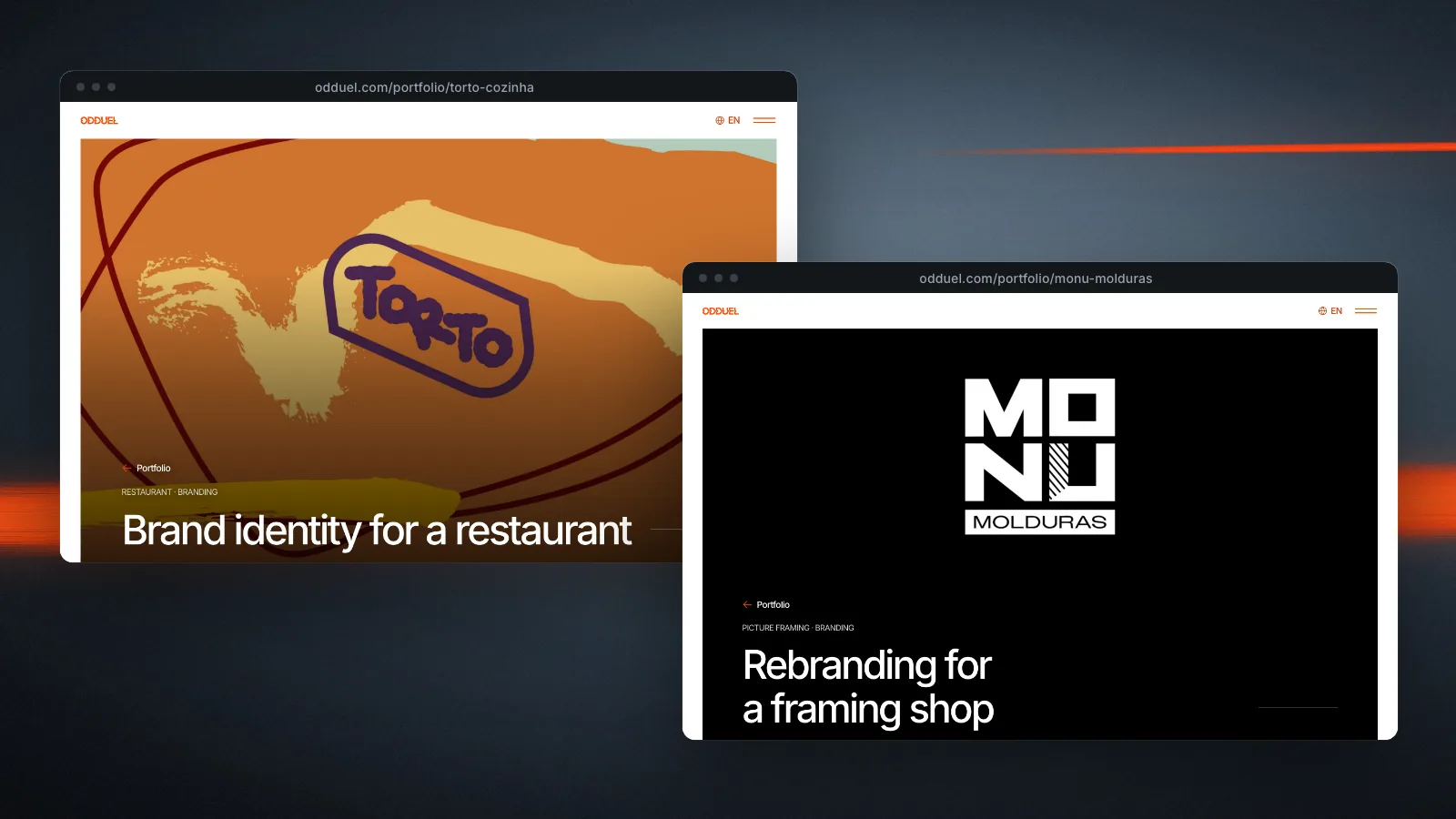
- Torto Cozinha, a restaurant in São Paulo whose kitchen starts from French cooking and takes it somewhere else. Its identity behaves the same way: a hand-drawn logo in sixteen arrangements, a palette that runs from loud to quiet, libraries of brushstrokes and bent forks, and a manual with one rule above the others: the logo must always be read, and may otherwise do as it pleases.
- MONU Molduras, a picture framing shop in São Paulo. A rebranding in black and white only: four letters drawn as blocks, a hatched stroke cut on a slant like the mitre at the corner of a frame, a symbol, a family of signatures and a pattern. The colour is left to whatever goes inside the frame.
- Nothing To Eat, a sandwich brand from Amsterdam. Identity, packaging and the website at nothingtoeat.online, all built on the joke in its name: the logo says “NOTHING” on every bag and box, a small red cross beside it says otherwise, and that cross, repeated, becomes a pattern you can spot across the street.
Four sectors, four personalities; in each case the identity is small enough to learn and strict enough to hold.
What are the common branding mistakes?
The problems we see most often in growing companies:
- Designing before deciding. Choosing a logo before agreeing the position leads to long, subjective debates.
- Following the category. If every competitor uses blue and the same stock photography, so will you unless you decide otherwise.
- Too many stakeholders, too late. Involve the people who must approve the brand at the strategy stage, not when designs are nearly final.
- No owner after launch. Someone inside the company must be responsible for the brand, with the authority to say no.
- Stopping at the logo. Without templates, guidelines and a website that carries the identity, people improvise, and the brand drifts within months.
AI helps with some of these: we use it to produce many applications of an identity quickly, so a system is tested on real material early, and to check consistency across large sets of assets. The judgement about what makes the brand distinctive stays with the designers and with you. If you are also choosing who to do the work with, our note on a new agency against an established one sets out what to ask.
Questions people ask
How much does branding cost for a small company?
It depends on whether you need strategy, naming, a full identity system and applications, or a refresh of what exists. In our experience a refresh is a modest project; strategy, a full identity, guidelines and a website together are a significant one, though far less than before AI carried the production. Ask any agency to show the scope behind the figure.
How long does a branding project take?
A refresh can take a few weeks. Strategy, a full identity and guidelines usually take one to three months, depending less on design time than on how quickly decisions and approvals come back.
Brand strategy or brand identity: the difference?
Brand strategy is the thinking: who you serve, what you stand for, how you want to be seen. Brand identity is the visible and audible result: logo, typography, colour, imagery and voice. Strategy comes first and is written down; identity is designed to express it and judged against it.
When should a growing company rebrand?
When the business has changed what it offers or whom it serves, when the current identity is holding back sales or recruitment, or when a merger or a new market makes the old name misleading. If none of those applies, a refresh is usually enough and far cheaper.
If your company has outgrown how it looks and sounds, start with the strategy, then design a system you can live with and a website that carries it from day one. Read how we approach it on our branding service page, or talk to us about your project.
Further reading: Starting a company in 2027: the digital foundations.