Most advice on choosing an agency compares size: boutique or big, small or large. Age decides more. In the choice of new agency vs established agency, long experience has always looked like the safe side, yet much of what your project has to win in, from the way people search to the tools the work is made with, changed in the last few years. This article makes the case for the newer agency, says plainly where that case stops, and shows how to judge one that has no twenty-year history to point to.
New agency vs established agency: what really differs?
Age alone tells you little. A firm founded last year can be careless, and one founded thirty years ago can be superb. What age shapes is how the work is organised, and that is what you are buying.
An established agency was built for the conditions of its early years. Its departments, its approval chain, its price list and its software were chosen when projects were made differently, and each is now defended by the people whose jobs depend on it. Changing any of them means retraining staff, rewriting contracts and disappointing someone. So change comes slowly, and clients pay for the old way in the meantime.
A new agency has none of that to protect. It chooses its tools, its method and its structure for the market as it is now. The difference shows in four places:
- Speed. Fewer layers between your decision and the people making the work.
- Method. A process designed around current tools, not adapted to them late.
- Knowledge. A working understanding of how people search, compare and buy today.
- Value. More of the budget spent on the work, less on running the agency.
Why does a new agency deliver faster?
Speed in an agency is seldom about how quickly anyone designs or writes code. It is about how long a decision waits.
In a large, long-established firm, work often passes from the person who sold the project to an account manager, then a project manager, then a department head, then the person who makes it, and back up the same ladder for approval. Each handover adds a meeting, a summary and a chance for the brief to lose something. Weeks go by in which nothing is wrong and nothing moves.
A newer agency is flatter, by necessity at first and by design if it is well run. You speak to the people who decide, and often to the people who do the work. A question asked on Monday is answered on Monday. Your feedback reaches the designer in your words, not as a third-hand summary.
There is a second reason. A new agency has no production line to keep busy and no old contracts absorbing its best people. It can put the right specialists on your project from the first day and keep them there. That is how we built Odduel: a core studio sets the plan and holds the standard, dozens of specialist collaborators around the world join the briefs that call for them, and one person answers to you for the result.
What does AI change inside an agency?
Artificial intelligence is now the clearest line between agencies built recently and agencies still adapting. The tools are open to everyone. What differs is whether the process was designed around them or has had them added at the edges.
Used well, AI does not replace the judgement you hire an agency for. It removes the slow, repetitive labour around that judgement:
- Research. Markets, competitors and search demand read and summarised in hours, so strategy starts from evidence sooner.
- Drafts and options. More directions explored before one is chosen: more names, more layouts, more headlines, more storyboards.
- Testing. Code, content and interfaces checked more widely before release than a manual pass allows.
- Production. Versions, formats and language editions prepared far faster than by hand.
- Analysis. Results read continuously, so the next decision rests on what happened, not on what was hoped.
For a client the effect is simple: the same budget buys more. More depth in the thinking, more options tested, more finished work delivered. An agency that still does all of this by hand bills you for the hours. An agency that added the tools last year is still learning where they fail.
One condition matters. Every piece of work must still be decided, checked and signed off by a person who answers for it. AI makes confident mistakes, and an agency that publishes its output unreviewed is saving its own time at your expense. Ask any agency, new or old, who reviews what the tools produce. We hold our own process to the discipline we build into clients’ products through AI development.
Does a new agency know today’s buyer better?
It should, because it has nothing older to unlearn. The way people find and choose a company has shifted sharply. Buyers ask an AI assistant for a shortlist, read an AI summary above the search results, check a brand on social video and expect a website or an application to respond at once on a phone.
An agency whose instincts were formed when search meant a page of ten links, and a brand lived mostly in print, has to translate each of these shifts into its old way of working. A newer agency starts from them. In practice:
- A brand identity is designed first for screens, motion and small sizes, then carried into print. See how we approach branding.
- Content is written to be found and quoted by AI systems as well as ranked. Google’s guidance on AI features and your website says there are
no additional requirements to appear in AI Overviews or AI Mode
: sound fundamentals, done properly, are what count. - Websites and applications are built on current, well-supported technology, not on the platform an agency is tied to because its developers know nothing else.
How do you judge a new agency without a long track record?
This is the fair objection, and a good new agency welcomes it. A long client list is the easiest proof to read, but it describes the past, and often the work of people who have since left. You can test a newer agency on things that predict your own project more directly.
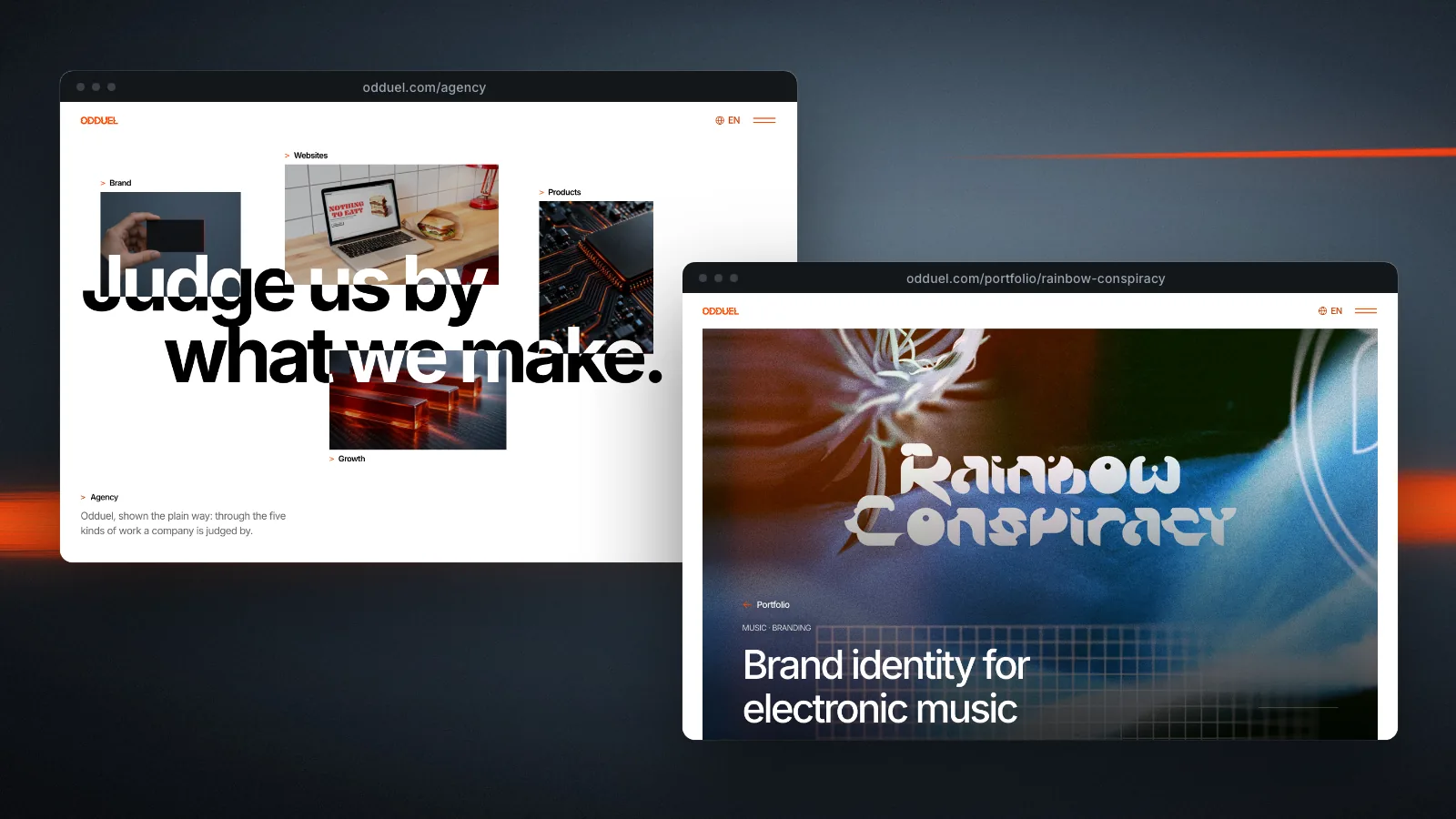
- Look at the work, not the logo wall. A few real projects shown in detail tell you more than fifty names. Ask what the agency did on each and what it did not. Our portfolio is the place to start; the brand identity for Rainbow Conspiracy shows the level of detail to expect.
- Ask who will do the work. Names, roles and how much of their time. Experience lives in people, not in a founding date.
- Read the plan. Scope, timeline, cost and measures of success in writing before anything is made. A vague proposal is a warning at any age.
- Judge the agency’s own presence. Its website, its writing and the speed of its replies are samples of what you will receive.
- Start small if you are unsure. A defined first phase with a clear deliverable shows how the agency works before you commit the full budget.
- Check the practical side. Who owns the files and the code, what happens if a key person leaves, and how the handover works at the end.
When is an established agency the right choice?
Sometimes it is, and an honest comparison has to say so. An established firm is likely to be the better call when:
- You need physical scale: staffed offices in many countries, or hundreds of people on one account at once.
- Your procurement rules require years of audited accounts, particular certifications or a set number of comparable references.
- The work depends on long-standing relationships, such as media bought at volumes that earn negotiated rates.
- You are maintaining an old system that only its original specialists still understand.
If none of these applies, the weight of an established firm is mostly a cost. And reputation deserves a second look: it was earned by particular people on particular projects, and it says nothing about who will be assigned to yours.
What you get from Odduel
We are a new agency, and we built Odduel for the buyer this article describes: a company that intends to lead its market and wants a partner working at today’s pace.
Odduel is full service: brand, websites, applications, AI, content and growth, planned together so that what one specialist decides the next one builds on. We work from Barcelona and São Paulo with collaborators around the world. AI runs through our own process, with people deciding and answering for every result. Each project has a written plan and a lead who answers for all of it. How we are organised is set out on the Agency page.
We will not show you a wall of logos collected over decades. We will show you the work, the people, the plan and the pace, and let you judge.
Questions people ask
Is it risky to hire a new agency?
It carries a different risk, not necessarily a larger one. With a new agency the risk is a short history, which you reduce by checking the people, the plan and a first phase of work. With an established one the risk is paying for layers of process and being handed to a junior team, which is harder to see before you sign.
Is a new agency cheaper than an established agency?
Often, but price is the wrong comparison. A newer agency usually carries less overhead and works with current tools, so more of the fee goes into the work. Compare what each proposal delivers for the budget: depth of research, options explored, finished pieces and support after launch.
Is a new agency the same as a small or boutique agency?
No. Size and age are separate questions. A boutique agency can be decades old and set in its ways, and a new agency can draw on a wide network of specialists. Whatever the head count, ask how the work is organised and who does it.
How should an agency use AI on my project?
For the labour around the decisions: research, first drafts, testing, the production of versions and the analysis of results. A person should still make every decision, review every output and answer for the result. Ask which parts of the work the tools touch and how your data is handled.
How can I check a new agency before signing?
Ask to see real work in detail, meet the people who will do yours, and get scope, timeline, cost and measures in writing. If doubt remains, agree a small first phase with a clear deliverable before you commit the full budget.
If you are weighing a new agency against an established one for a brand, a product or a new site, tell us about the project. You will get a straight answer on whether we are the right fit, and a written plan if we are. And if a new site is where it starts, see how we approach website development.