Branding is the work of deciding what a company stands for and expressing it consistently in its name, identity, voice and every experience people have with it. For a European company, good branding starts with a clear position, turns it into a usable identity system and protects it with trade marks and guidelines, so that every website, product and campaign builds the same reputation. This guide is written for the people who commission branding: where to start, what a project involves, what drives the cost, how to protect a brand in the EU, how to choose a partner and how to measure whether it works.
Last updated: 2 November 2026.
What is branding?
Branding is the deliberate shaping of how people recognise, understand and remember a company. It covers the strategy (who you serve, what you promise, how you differ), the identity (logo, colour, type, imagery, motion) and the voice (how you write and speak), plus the rules that keep all of it consistent.
A brand is what people think and feel about you. Branding is the work you do to influence it. The distinction matters, because a new logo alone rarely changes what people think; consistent experiences do.
For the foundations and vocabulary in more depth, our branding guide explains each element. This article focuses on running a branding project well. At Odduel, a creative and technology agency in Barcelona and São Paulo, our branding service takes companies from position to a working identity system across print, screens and products.
In short: agree your position before any design. Brief for problems, not for a logo. Expect strategy, identity and guidelines as separate outputs. Check the name and mark for trade mark conflicts early. Roll out in order of what customers see most. Measure recognition, consistency and commercial results over months, not days.
When does a company need branding work?
A company needs branding work when what it is has outgrown how it looks and sounds. Common triggers:
- A new company or product that needs a name, identity and voice before launch.
- A change of strategy: a new market, a new audience or a move upmarket.
- Inconsistency: different logos, colours and tones across teams, countries and channels.
- A merger or spin-off where two identities must become one, or one must become two.
- Expansion across Europe, where a name or message does not travel well between languages.
- A dated identity that no longer works on phones, in motion or at small sizes.
Not every case needs a full rebrand. Sometimes a refresh of type, colour and guidelines solves the problem at a fraction of the effort.
Where should a company start with branding?
Start with strategy, written down and agreed by the people who will defend it. Design built on an unclear position gets argued over on taste.
- State the business goal. Growth in a new segment, higher prices, recruitment, investment or international expansion.
- Describe the audience. Who chooses you, who influences the choice and what they value.
- Map the competition. How others in your category look and talk, so you can stand apart.
- Define the position. What you offer, for whom, and why you rather than the alternatives. Our guide to brand positioning explains how to write one.
- Audit what exists. Every place the brand appears today: site, product, packaging, signage, documents, social profiles.
- Agree scope and decision-makers. Who approves, in how many rounds, and what is in and out of scope.
What does a branding project involve in practice?
A branding project involves four phases, each with its own deliverables.
Strategy
Research, interviews and workshops lead to the positioning, the brand’s personality, its key messages and, where needed, a naming brief. The output is a short strategy document the whole company can read.
Identity design
Designers explore directions, then develop one into a full system: logo and its versions, colour palette, typography, imagery style, graphic elements, iconography and motion principles. Good identities are tested early on real applications: a website header, a social post, a sign, a product label.
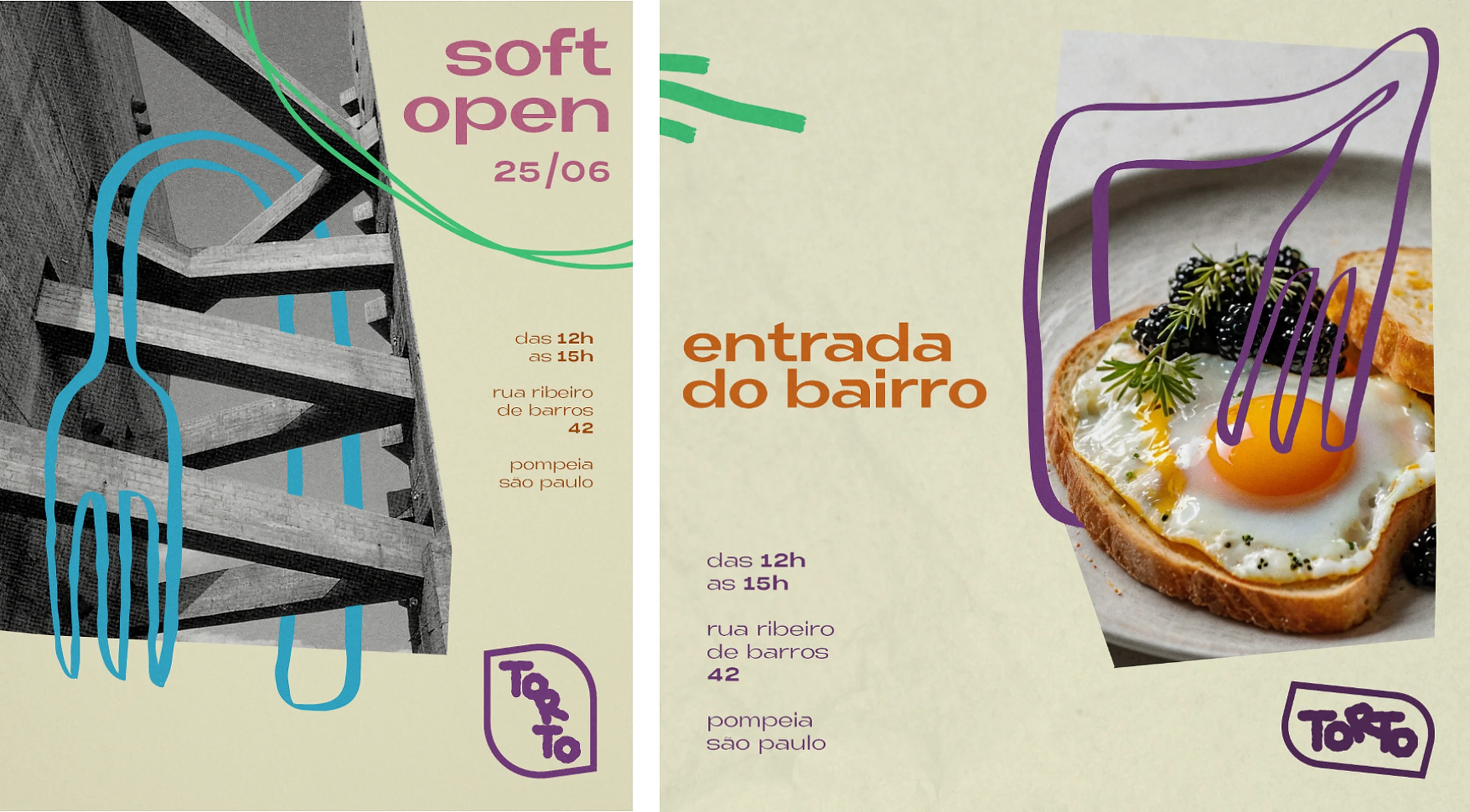
Our work for Torto Cozinha shows what a system looks like in use: a logo with several arrangements, a palette, illustrations and layouts applied across menus, posters and signage.
Voice and messaging
Voice turns the position into words: tone, vocabulary, sentence style and example copy for headlines, product descriptions and replies. For European companies this includes how the voice works in each language, which is adaptation, not word-for-word translation.
Guidelines and rollout
Brand guidelines document the system so others can use it correctly, with templates for the most frequent materials. Rollout updates every touchpoint in a planned order.
What does a branding project deliver?
Deliverables vary with scope. A clear proposal lists them, so you can compare offers.
| Deliverable | What it is | Why it matters |
|---|---|---|
| Brand strategy | Position, audience, personality, key messages | Gives every later decision a reason |
| Logo system | Primary mark, versions, sizes, clear space | Recognition across every format |
| Visual identity | Colour, type, imagery, graphic elements, motion | Consistency beyond the logo |
| Verbal identity | Voice, tone, vocabulary, example copy | Consistency in everything written |
| Guidelines | The rules and examples in one document | Lets others apply the brand correctly |
| Templates and assets | Files for documents, social media, presentations | Saves time and prevents drift |
| Applications | Website, packaging, signage, stationery | Where customers meet the brand |
What drives the cost of branding?
The cost of branding depends on the depth of strategy, the breadth of the identity system and the number of applications. We do not publish price ranges because a fair figure follows a brief, but every quote is built from these lines.
- Strategy depth: desk research and one workshop cost a fraction of interviews across markets and audiences.
- Naming: creating and checking a new name adds research, linguistic checks and trade mark searches.
- System breadth: a logo with basic colours and type is small; a full system with illustration, iconography and motion is large.
- Applications: each packaging range, sign family or set of templates adds design and production work.
- Languages and markets: messaging and checks in several languages add time.
- Guidelines: a short PDF costs much less than a full online brand centre with downloadable assets.
- Rounds and decision-makers: many approvers and open-ended revisions extend every phase.
Ask for each line to be visible and for the number of design rounds to be stated.
How do you protect a brand in the EU?
You protect a brand mainly through trade mark registration and clear ownership of the design files.
- Search before you commit. Check that the name and logo do not conflict with existing marks in your classes of goods and services, in the countries where you trade.
- Register. A European Union trade mark, governed by the EU trade mark regulation and filed with the EU Intellectual Property Office, gives protection across all EU member states with one application. National marks cover single countries, and the UK and Switzerland need their own filings.
- Secure domains and profiles. Register the main domains and social handles you need before you announce the name.
- Own the work. Your contract should transfer the rights to the logo, identity and source files to you.
A trade mark attorney gives the final opinion; your branding partner should flag risks early so you do not fall in love with a name you cannot use.
How do you choose a branding partner?
Choose a partner whose process starts with your business, not with their style.
- Look for range. A portfolio where every identity looks different suggests the work responds to each client.
- Look at systems, not just logos. Ask to see identities applied to real websites, packaging and signage.
- Ask about strategy. They should explain how positioning shapes design decisions.
- Ask about digital use. The identity must work on phones, in motion and in interfaces, not just on paper.
- Check rights and files. You should receive editable source files and full rights.
- Ask about rollout support. Templates and help applying the brand matter as much as the launch.
Our identity for Rainbow Conspiracy is an example of a system built for screens and light as much as for print.
How do you roll out a new brand?
Roll out in order of visibility and cost, with a date for each touchpoint.
- Digital first: website, social profiles, email signatures and templates, which are quick to change and seen most.
- Sales and service materials: presentations, proposals, documents and packaging in production.
- Physical touchpoints: signage, vehicles and printed stock, replaced as they run out where possible.
- Partners and listings: directories, marketplaces and partner sites.
- Internal launch: explain the why to staff before the public launch, so they can carry it.
Social media is where inconsistency creeps in fastest; our article on social media brand guidelines covers the rules teams need there.
How do you measure whether branding works?
You measure branding over months, against the goal set at the start.
- Recognition and recall: surveys or search volume for your brand name.
- Perception: whether people describe you the way your position intends, in surveys, reviews and sales conversations.
- Consistency: an audit of touchpoints against the guidelines.
- Commercial signals: price tolerance, conversion rates, enquiry quality and recruitment response.
- Internal use: whether teams use the templates and assets, or work around them.
Agree two or three of these before launch and record the starting point, so the change can be seen.
Questions people ask
What is the difference between branding and a logo?
A logo is one element of a brand’s identity: the mark people use to recognise you. Branding is the wider work of defining what the company stands for and expressing it consistently in its identity, voice and experiences. A new logo without a clear position and consistent use rarely changes how people see a company.
How long does a branding project take?
A focused identity refresh can take a matter of weeks. A full branding project with strategy, naming, a complete identity system and guidelines usually takes a few months. The schedule depends most on the depth of research, the number of decision-makers and how quickly feedback comes back after each round.
Should a European company register an EU trade mark?
If you trade in several EU countries, an EU trade mark is usually the most efficient protection, because one application covers all member states. Search for conflicts first, in the classes of goods and services you use. The UK and Switzerland need separate filings, and a trade mark attorney should confirm the strategy.
When is a rebrand better than a refresh?
A refresh suits a company whose position is still right but whose identity looks dated or inconsistent: type, colour and guidelines are updated, and recognition is kept. A rebrand suits a real change in strategy, audience, ownership or name, when the old identity would hold the company back. The strategy phase usually makes the choice clear.
What should brand guidelines include?
Brand guidelines should include the brand’s position and personality, logo versions and their use, colour, typography, imagery, graphic elements, voice and tone with examples, and templates for common materials. They work best when they show right and wrong examples and are easy to find and update, rather than a static file nobody opens.
Write down your position in two sentences and list every place your brand appears today: those two things frame any branding project. When you want to build on them, see our branding service or tell us about your brand.