Ecommerce website development in 2027 is not about getting a shop online, which any platform can do in an afternoon. It is about building a shop that sells again and again at a healthy margin. That rests on five decisions: the business model, a platform that fits how you operate, product pages that answer every question, a checkout with nothing in the way, and the operations and data behind it all. This guide takes each in turn, says what to decide first and what can wait, and explains how AI now carries the heavy parts of building and running an online store.
Last updated: 25 October 2026.
Which business model should the shop follow?
Before platforms, themes and design, decide how the shop makes money. The model shapes everything that follows, from the catalogue structure to the checkout.
- Direct to consumer: your own products under your own brand, with full control of margin and customer data.
- B2B ordering: price lists per customer, repeat orders, invoices and account terms.
- Subscription: recurring deliveries or access, with billing and retention at the centre.
- A marketplace beside your own shop: reach through the large platforms, brand building through your own site.
- Made to order: configurators, lead times and sometimes a quote instead of an instant purchase.
Each model asks for different things: a subscription business lives or dies by account management and billing, a B2B shop by search, quick reordering and customer-specific pricing. Selling into several countries adds currencies, taxes, duties and returns from day one, and that belongs in the brief.
Which platform fits your shop?
The platform is the engine of the online store. For most growing companies the choice is between a hosted platform, which trades some control for far less maintenance, and an open-source one, which trades some maintenance for full control. Our guide to choosing a CMS sets out how we weigh that for websites in general; for a shop, five questions settle it.
What to decide first
- Catalogue size and complexity: variants, bundles, configurable products, made-to-measure items.
- Integrations you cannot do without: stock, accounting, ERP, shipping carriers, payment providers.
- Markets and currencies on the day you open.
- Who runs the shop day to day, and what they are comfortable doing without a developer.
- The total cost over three years: subscriptions, transaction fees, apps, hosting and maintenance, not only the build.
| Question | Points towards a hosted platform | Points towards open source |
|---|---|---|
| Catalogue | Standard products and variants | Configurators, unusual pricing rules |
| Integrations | Off-the-shelf connectors are enough | Deep ERP or warehouse logic |
| Team | No developer in house | A developer or a partner on call |
| Control | Convenience first | Ownership of data and code first |
What to leave for later
Loyalty schemes, advanced personalisation, headless storefronts and complex promotion engines can be added once the shop has real customers and real data to justify them. Launching with them tends to delay the opening and complicate the first months.

What makes a product page sell?
The product page is where the sale is won or lost. A shopper cannot touch the product, so the page must do the work of a good shop assistant: show it, explain it, reassure, and make the next step obvious. Good product pages include:
- Clear, honest photography from several angles, in context and in detail.
- A title and a price visible at once, with stock and delivery information close by.
- A description written for buyers: what it is, who it suits, what it is made of, sizing, care.
- Reviews, if you have real ones; never invented.
- Related products placed to help rather than distract, so a suggestion raises order value because it is genuinely useful.
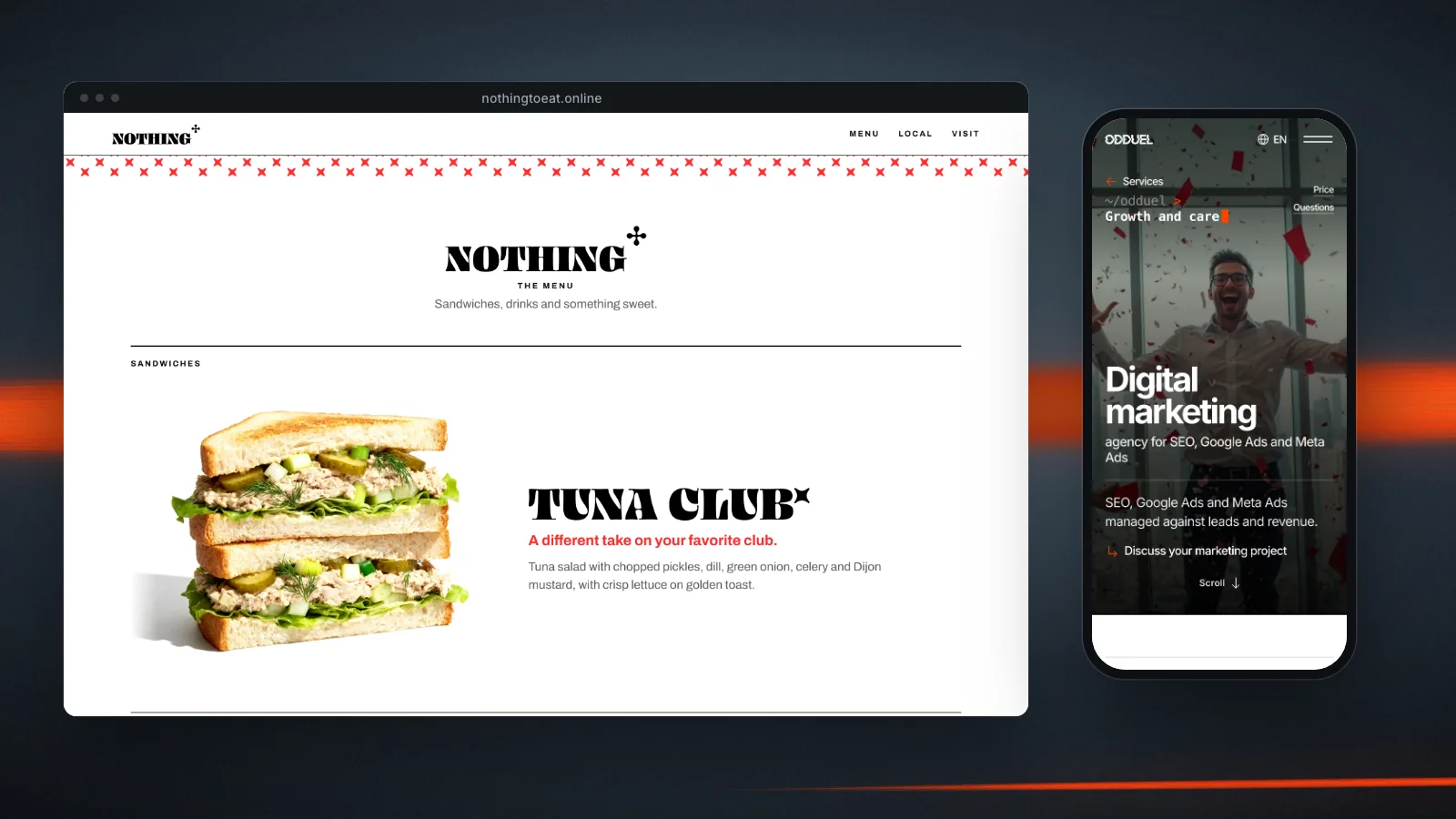
The Nothing To Eat website we built shows the principle at the simplest scale: each sandwich has its photograph, its name, one line and a plain description, and the button at the top of the page leads straight to that menu. A product page for a shop with hundreds of items does the same job, only with stock, delivery and variants added. The structure and hierarchy of those pages is UX/UI design work, and it is where a shop earns its margin.
AI is especially useful here. At Odduel we use it to draft product descriptions from structured data, write first-pass alt text, prepare translations for review and cut image variations for every screen size, with an editor checking every line for accuracy and tone. For a catalogue of hundreds of products, that turns weeks into days and frees budget for photography and design.
What makes a checkout convert?
Checkout is where most avoidable losses happen. Research into cart abandonment has pointed to the same culprits for years: costs that appear at the last step, a forced account, and forms that ask for more than the order needs. In our experience the shops that convert best are the ones that remove those three things before they touch anything else.
Principles for a checkout that converts:
- Show shipping costs and delivery times before the checkout, on the product page if you can.
- Allow guest checkout; offer an account after the order, not before it.
- Ask only for what the order needs.
- Offer the payment methods your market expects, wallets included.
- Make errors clear, in place, and easy to fix.
- Keep the page fast and the brand calm: no banners, no second navigation.
Test the checkout with real cards before launch and after every change to the platform: it is the one page where a small bug costs money every hour.
Which operations must the shop support?
A shop is a front end on top of operations. The best design in the world cannot hide late deliveries or wrong stock. Plan for:
- Stock synchronisation between the shop, the warehouse and any other channel you sell through.
- Order flow: confirmations, picking, shipping, tracking, returns.
- Customer service: clear policies, quick answers, a help page that answers the common questions before they are asked.
- Payments and fraud handled by a reputable provider, never by your own code.
- Legal requirements: terms, privacy, cookie consent and consumer rights in each market.
Automate the dull parts. Order confirmations, shipping updates and stock alerts should not need anyone to press a button. After launch, a maintenance and support arrangement keeps the platform, its apps and its payment integrations current.
How does AI change ecommerce website development?
Two years ago a custom shop was a six-month project, and most of the budget paid for production: building each template by hand, wiring up the same integrations for the tenth time, preparing every image in every size, writing every product description, testing every page on every screen. That is the work AI now carries. At Odduel the first draft of a theme’s components, the front-end code of a page type, the catalogue content, the image cuts, the test scripts and the first pass of a translation are produced with AI and then reviewed, corrected and finished by a designer or a developer.
What that changes, in our experience, is the shape of the project. A focused shop opens in weeks rather than months; a larger one with integrations is released in phases over weeks. And the budget moves to where a shopper notices it: the strategy, the concept, the art direction, the brand voice, the product photography and the final review of every page. Those remain people’s work, in Barcelona and São Paulo, and they are the difference between a shop that is live and a shop that sells. We explain the arithmetic in how much a website costs; the same logic applies, with the catalogue and the integrations as the main variables.
How does the shop grow after launch?
After launch the work shifts to bringing the right visitors and turning more of them into repeat customers.
- Search: category and product pages built to rank, with clean addresses and structured data; our SEO guide for 2027 covers what matters now.
- Email: welcome, abandoned cart, post-purchase and replenishment messages, often the most profitable channel a shop has.
- Paid media: shopping and social campaigns measured on margin, not only on revenue.
- Content: guides and stories that help people choose.
- Analysis: conversion by device, page and source, reviewed monthly and acted on.
Our digital marketing work starts from the margin a shop needs and works back to the spend and the channels that can deliver it.
Launch checklist for a new shop
Before the doors open, run through these checks on staging and again on the live site:
- Place real orders with each payment method and refund them.
- Test shipping costs for every zone and weight band.
- Check tax calculations in each market you sell to.
- Confirm that order, shipping and refund emails arrive, look right and read well.
- Test the shop on several real phones, not only in a desktop browser at a narrow width.
- Check that stock levels update after an order and after a return.
- Verify analytics and conversion tracking, with consent respected.
- Make sure the legal pages, cookie consent and returns information are in place.
- Set up redirects from any old shop addresses.
- Agree who answers customer questions in the first weeks, and how quickly.
A calm, tested launch earns trust from the first order. A rushed one sends customers to support before they ever come back to buy.
Questions people ask
How much does an e-commerce website cost?
It depends on the catalogue, the integrations, the markets and the level of design. In our experience a shop on a hosted platform with a customised theme costs a fraction of a custom build with ERP integration, and AI-assisted production has brought both down. Budget for running costs too: subscriptions, transaction fees, apps, hosting and maintenance.
How long does it take to build an online store?
A focused shop with a standard catalogue can open in a few weeks. A shop with integrations, several markets or a configurator is released in phases over a few months. The catalogue content and the checkout testing are usually the long items, and AI shortens the first of them considerably.
Shopify or WooCommerce: which should I choose?
Shopify suits a company that wants convenience and no developer in house; WooCommerce suits one that wants ownership of its code and data and has a developer or a partner on call. Neither is wrong for a standard catalogue. The deciding factors are the integrations you need, who runs the shop and the total cost over three years.
What should I ask an e-commerce agency before hiring them?
Ask for live shops they built and still support, how they handle integrations and data migration, how they test the checkout, who owns the store and its data, and what support looks like after launch. Ask too how they use AI in production and what stays human work.
Can an existing shop be improved without rebuilding it?
Often, yes. Shipping costs shown earlier, guest checkout, better photography and a faster page can lift conversion without touching the platform. A rebuild makes sense when the platform blocks an integration you need, when maintenance has become the main cost, or when the model has changed.
If you are planning a new shop or replacing one that underperforms, start with the model, then the platform, and keep the launch list short. Our e-commerce development service covers the whole of it, from strategy and platform choice to launch and growth, or talk to us about your project and we will tell you plainly what it would take.