
The first two weeks with a new agency decide how the rest of the project feels. Good agency onboarding covers four things in that time: a kick-off that fixes the goal and the decision-makers, a short discovery phase that tests the brief against reality, the hand-over of access and assets, and a first plan you can hold the agency to. If you reach the end of week two without those four, the project is already running on assumptions.
Last updated: 26 October 2026.
This guide explains what each step involves, what you should be asked for, and what you should have in your hands by day fourteen.
What happens at the kick-off?
The kick-off is a working session, not a ceremony. Its job is to turn a signed proposal into shared understanding. Expect it to last two to three hours and to cover:
- The goal in one sentence. Not “a new website” but “more qualified enquiries from operations directors in Spain and Portugal”.
- Who decides. One person on your side who signs off, and the names of anyone whose opinion can stop work. Late reviewers are the most common cause of rework.
- Constraints. Fixed dates, legal requirements, systems that cannot change, brand rules that are not up for discussion.
- How you will talk. Where messages go, how often you meet, how feedback is given and by when.
At Odduel we send a short written summary of the kick-off the same day. If something in it is wrong, it costs a reply to fix rather than a week of work in the wrong direction. Our offices are in Barcelona and São Paulo, so a kick-off with a client in either time zone happens in working hours; the summary is what both sides work from after that.
What does discovery involve?
Discovery is where the agency checks whether the brief describes the real problem. For most website and product projects it takes between three days and two weeks, depending on how much is already known.
Typical activities:
- Interviews with the people who sell, support and run the product, and ideally with two or three customers.
- An audit of what exists: analytics, search performance, content, technical set-up, the brand in use.
- A look at the market: how competitors present themselves and where they leave room.
- A list of hypotheses: what we think will move the goal, ranked by impact and effort.
This is also where AI earns its place in our process. Transcribing interviews, clustering hundreds of support tickets, crawling an existing site and summarising its content used to take days of manual work. We now do that groundwork in hours and spend the saved time on the part that needs judgement: deciding what matters.
The same applies later in the project, where AI carries the repetitive production (design-system components, front-end code, first drafts, image preparation, testing) and the people on the project spend their time on strategy, concept, art direction and the final craft. The result is a project that costs less and is delivered in weeks, with the budget going where the quality is decided.
What discovery should hand back
Discovery ends with a short document, not a slide show. In our experience it fits on a few pages: what the goal is in measurable terms, what the audit found, what the interviews changed, and the three to five hypotheses the plan will be built on. If discovery was commissioned as a stand-alone piece, that document is what you own; you can take it to any website redesign or build, with us or elsewhere.
Which access and assets should you hand over?
Nothing stalls a project like waiting for logins. In the first week the agency should send you a single list of what it needs, and you should be able to tick it off in one sitting. A typical list:
| Item | Why it is needed |
|---|---|
| Analytics and search console | To measure the starting point |
| Hosting, domain and DNS | To plan the build and the launch |
| CMS or store admin | To audit content and integrations |
| Brand files (logo, fonts, guidelines) | To design within the existing identity |
| Photography and video libraries | To know what can be reused |
| Contracts with other suppliers | To understand what can change |
Two habits protect you here. Give the agency its own named accounts rather than sharing yours, so access can be removed later without changing passwords. And keep ownership of domains, hosting and analytics in your company’s name, whoever manages them day to day.
If the brand files are thin, say so in week one. A project that needs a logo refresh, a type choice or a set of brand rules before the design can start is a different plan from one that inherits a finished identity, and it is better to know that on day three than on day thirty. Our branding service is often scoped in exactly this moment, as a short first phase before the site.
What should the first plan contain?
By the end of week two you should receive a plan that is specific enough to disagree with. It should state:
- Scope, confirmed or adjusted after discovery, with anything removed written down.
- Milestones with dates, and what you will review at each one.
- Your tasks and their deadlines: content, approvals, feedback rounds. A good plan is honest about the client’s share of the work.
- Risks and what will be done if they happen.
- How success is measured after launch.
If discovery changed the picture, this is the moment to say so. It is far cheaper to adjust scope on day fourteen than on day sixty. When you choose a digital agency, ask to see an example of a plan like this from a past project; it tells you more about how the agency works than any credentials page.
The plan should also say how the work will be shown to you. At Odduel we show options rather than a single answer: several directions for a brand, several layouts for a key page, each one built far enough to judge. That is possible in weeks because the production behind each option is fast; the choice between them is yours and ours, and it is where the time goes.
What should agency onboarding give you?
By day fourteen, a well-run agency onboarding leaves you with evidence rather than reassurance. Check for:
- A written kick-off summary you agreed with.
- Discovery findings presented to you, with the reasoning visible.
- Every access request either granted or explained.
- A dated plan with your responsibilities in it.
- A first glimpse of direction: for a site, perhaps a sitemap and early sketches of key pages; for a brand, a set of territories to react to.
A worked example
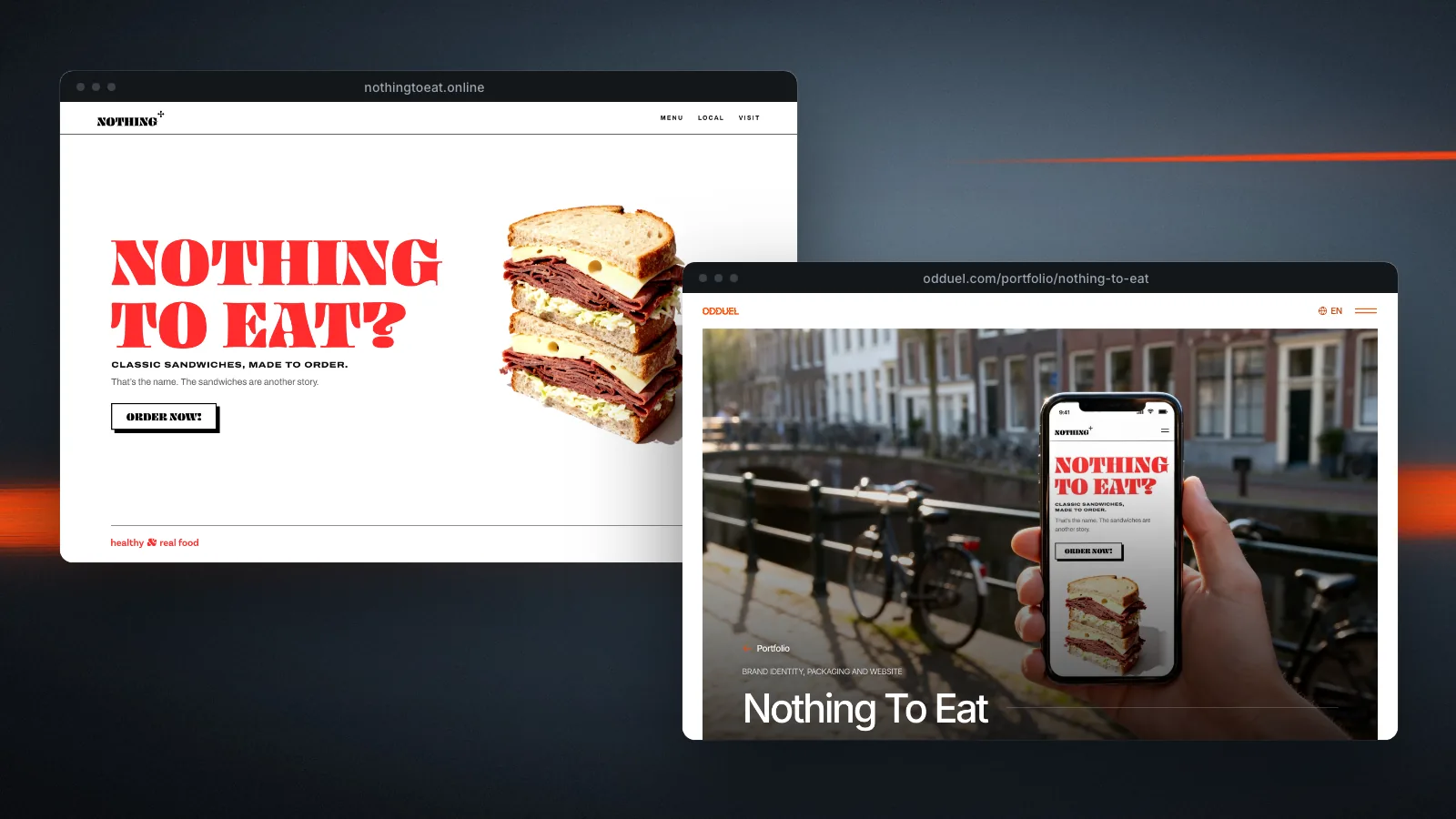
For Nothing To Eat, a sandwich brand in Amsterdam, the identity came first. The kit of wordmark, pattern and packaging was settled before a page of the website was designed, so the site was built around the brand rather than the brand squeezed into a template.
The order of work was decided in the first fortnight: brand kit, then the website, then the material that presents both. Nothing about the scope was unusual, but having the order written down meant that each piece arrived with the one before it already approved.
If you are still deciding who to hire, our guide to how to choose a digital agency covers the questions that test an agency’s onboarding before you sign, and new agency vs established agency explains why a younger studio can run a tighter first fortnight. If your project is mainly an interface, our guide to UX and UI design explains what the design phase that follows looks like.
Questions people ask
What is the first step of agency onboarding?
The kick-off meeting. It confirms the goal, the person who signs off and the constraints, and it sets how you will communicate. Everything else in the first two weeks depends on it.
How do I know the onboarding is going well?
You have a written summary of the kick-off, your access list is closed, discovery findings have been shown to you, and you hold a dated plan by day fourteen. If any of these is missing, ask for it directly.
Can we shorten discovery to save time?
Sometimes. If you already have research, analytics and a clear brief, discovery can be a few days of checking rather than two weeks of finding out. Skipping it entirely usually costs more later in rework.
Who should attend the kick-off on our side?
The person who signs off, the person who will manage the agency day to day, and anyone with a veto: legal, IT, sales leadership. Keep the group small but complete.
Should we pay for discovery separately?
It is reasonable either way. A separately priced discovery lets you commission it before committing to the build and gives you a document you own whatever happens next. Folded into the project, it is simpler to manage. What matters is that discovery is named, dated and has an output you can read.
If you are planning a new site and want to see how this first fortnight would run for your company, read about our website development service or talk to us about your project. We will show you the plan before you commit to it.