How much does branding cost? It depends far less on the logo than on how much thinking, how many applications and how many decisions sit around it: a logo on its own is a fraction of the price of a full identity system, and a strategy-led rebrand is the largest commitment of all. The honest way to compare prices is to compare what each quote includes, line by line, because two proposals with the same title can describe very different amounts of work. This guide explains what a branding project includes, compares four tiers of brand work, breaks a quote into its cost lines, sets freelancers, studios and agencies side by side, and lists the costs that often sit outside the quote.
Last updated: 20 October 2026.
What does a branding project include?
A branding project is the work of deciding what a company stands for and then giving that decision a form people can recognise: a name or a refined name, a logo, colours, type, a tone of voice, pictures and the rules that hold them together. The visible pieces are the end of the process, not the whole of it.
At Odduel, a creative and technology agency in Barcelona and São Paulo, we split branding work into four kinds of effort, and almost every quote you receive will contain some mix of them:
- Thinking: research, positioning, audience, competitors, the brand idea.
- Making: the logo, colour, type, graphic language, photography direction.
- Applying: the identity carried onto real things such as a website, packaging, signage, social templates and documents.
- Recording: the guidelines that let other people use the brand correctly once the project ends.
In short: the price of branding follows the amount of thinking, making, applying and recording a project needs. A logo-only job is mostly making. A full rebrand includes all four, at depth. When a quote looks cheap or expensive, the first question is which of the four it leaves out or puts in.
If you want the wider picture of how brand work fits into a growing company, our branding guide covers the process from start to finish.
How much does branding cost by tier?
There is no universal price list for brand work, and we do not publish one: a fixed quote follows a short brief, because the same tier can be light or heavy depending on the company. What we can say is how the tiers compare, what each includes and what pushes the cost up or down inside it.
| Tier | What it includes | Main cost drivers | Relative cost |
|---|---|---|---|
| Logo only | A wordmark or symbol, a few colour and size versions, final files | Number of concepts, rounds of revision, whether a symbol is drawn from scratch | The smallest; a fraction of a full identity |
| Identity system | Logo, colour palette, typography, graphic elements, a handful of applications, short guidelines | Number of applications, custom type or illustration, depth of the guidelines | Several times a logo-only job |
| Strategy plus identity | Research, positioning, brand idea, tone of voice, then the full identity system and guidelines | Interviews and workshops, number of audiences, naming, copywriting | Larger again: the thinking can weigh as much as the design |
| Rebrand | Audit of the current brand, strategy, new identity, roll-out plan and the replacement of existing materials | Number of touchpoints to replace, markets and languages, the change-over itself | Usually the largest, because roll-out adds to everything above |
Logo only
A logo-only job suits a company at the very start, testing an idea before it invests, or one that already has a clear voice and only needs a mark. The risk is that a logo without a system tends to be stretched badly: someone picks colours for the website, someone else chooses a font for the menu, and within a year the brand looks like three brands.
Identity system
This is the tier most growing companies need. It turns the logo into a working kit: colour with clear proportions, a type pairing, a graphic device or pattern, pictures that feel like the brand, and a set of real applications that prove the system works. Short guidelines close it.
Strategy plus identity
Here the project begins with questions rather than sketches: who the company is for, what it promises, why someone should choose it over the alternatives. The answers shape every design decision. The extra cost buys certainty that the identity says the right thing, not just that it looks good.
Rebrand
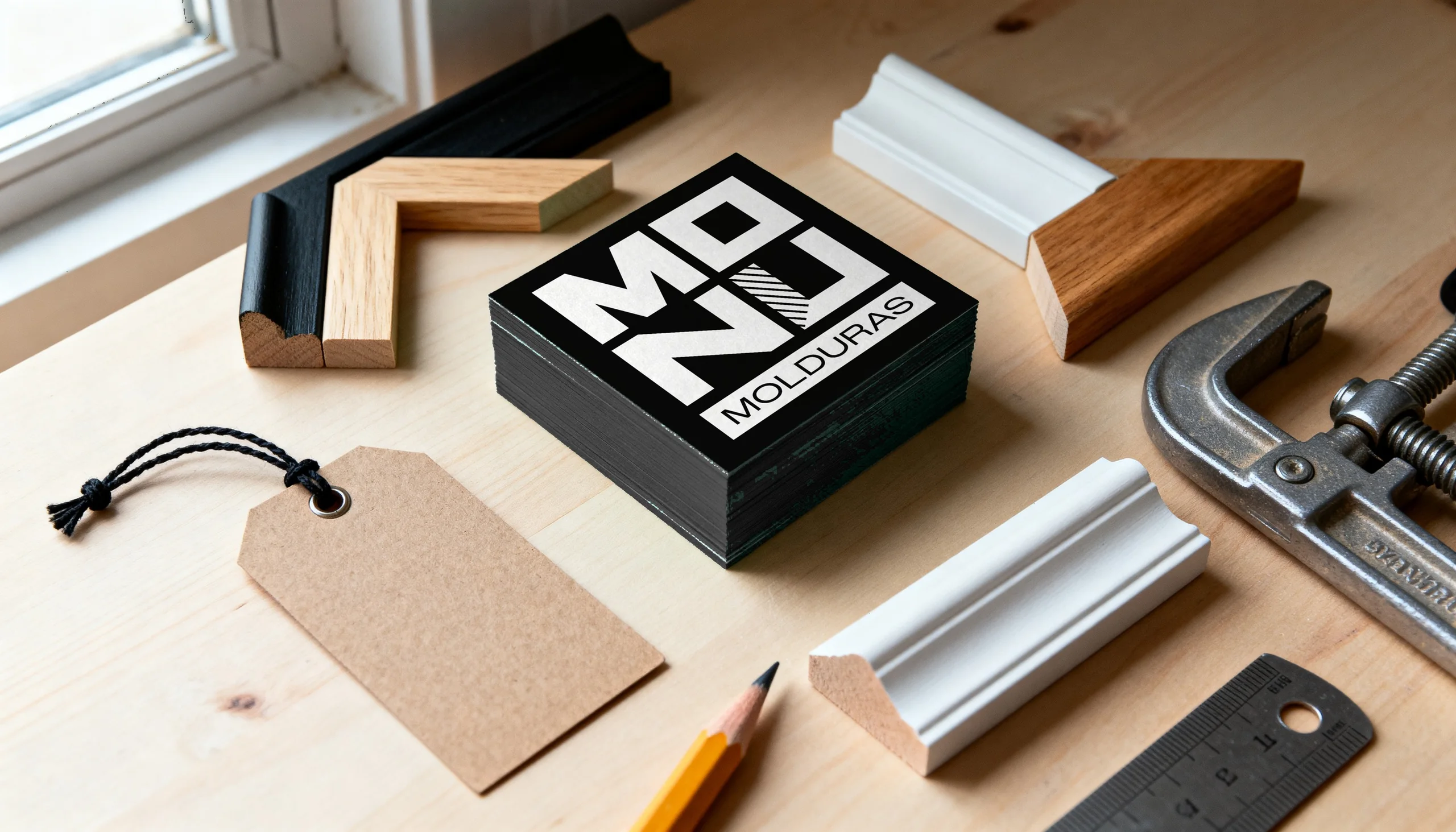
A rebrand replaces something that already exists, so it carries two extra costs: understanding what to keep, and changing everything over. Our work with MONU Molduras, a framing shop, was a rebranding: the new identity had to live on the shopfront, the packaging and the shop’s own materials, not only on screen.
What are the cost lines in a branding quote?
A clear branding quote breaks the price into lines you can read and question. These are the lines we expect to see, roughly in the order the work happens.
- Discovery and research. Interviews with the founders and sometimes customers, a look at competitors, a review of what already exists. Light for a logo, substantial for a rebrand.
- Strategy. Positioning, the brand idea, audience, values and voice, written down as a short document the design answers to.
- Concept design. The first visual routes. The number of routes presented is one of the biggest levers on cost: three routes cost more than one well-argued direction.
- Development and refinement. The chosen route is drawn properly: the logo refined, colour tested on screen and in print, type set, the graphic language built.
- Applications. Each application (website pages, social templates, packaging, signage, stationery, presentation templates) is a line in its own right. This line grows fastest.
- Guidelines. From a few pages of essentials to a full brand book with rules for every use.
- Production files and hand-over. Logo files in every format, colour values for screen and print, fonts or font licences, templates.
- Project management and revisions. Meetings, feedback rounds and the time spent keeping everyone aligned.
How the lines are weighted matters as much as which ones appear. In our experience the largest share of a serious identity project goes into the human work that cannot be shortened: strategy, concept, art direction, the brand voice and the final craft and review. The repetitive production around them, such as preparing file variants, setting up templates and resizing assets, is where we use AI and automation, so it takes a fraction of the time it used to and a project can be delivered in weeks rather than months.
Which line moves the price most?
Applications, almost always. A company that needs its identity on a website, three packaging formats, vehicle livery and a shopfront has a very different project from one that needs a logo, social templates and a presentation. Before asking for quotes, list every place the brand must appear in its first year. That list is the most useful thing you can send an agency.
Freelancer, studio or agency: which costs what?
Who you hire changes the price, but it also changes what you get and how much of the work stays with you. None of the three is the right answer for everyone.
| Freelancer | Design studio | Agency | |
|---|---|---|---|
| Typical scope | Logo, small identity | Identity system, sometimes strategy | Strategy, identity, applications and roll-out |
| Relative cost | Lowest | Middle | Highest per project, often lowest per application |
| Strategy | Rarely included | Sometimes, often light | Usually part of the method |
| Applications beyond print and social | Often outsourced or left to you | Some, design only | Website, digital products, content and campaigns can follow on |
| Capacity and continuity | Depends on one person | A small group | Several disciplines available at once |
| Your own effort | High: you coordinate the rest | Medium | Lower: the agency coordinates |
A freelancer can be excellent value for a defined, contained job. The hidden cost is coordination: if the brand then needs a website, packaging and photography, you become the person who keeps it consistent across several suppliers. A studio usually offers more depth in identity design. An agency costs more per project, but when the brand has to work immediately on a website, in a shop and in content, having those disciplines working from the same brief avoids paying twice for the same decisions.
For a fuller comparison of how to judge creative partners, see how to choose a graphic design agency.
How do you read a branding quote?
Comparing quotes is hard because each supplier describes the same work in different words. These steps make them comparable.
- Line up the four kinds of effort. For each quote, note how much thinking, making, applying and recording it includes. A low price often simply means no strategy and few applications.
- Count the concepts and the rounds. How many visual routes are presented, and how many rounds of revision are included on the chosen one? Ask what happens, and what it costs, after the last round.
- List the applications by name. “Brand applications” is not a scope. “Website home page design, three social templates, business card, A4 letterhead” is.
- Check the deliverables. Ask for the file formats, the colour values for screen and print, and whether editable source files are handed over.
- Check the licences. Fonts, stock pictures and illustration may carry licences that the client must buy or renew. A quote should say which.
- Ask who owns what. Make sure the transfer of intellectual property rights to you, on payment, is written into the contract, and that rejected routes are covered too if that matters to you.
- Look at the timeline. A very short timeline for a strategy-led project usually means the strategy is thin. A very long one for a logo usually means waiting, not working.
- Ask what is not included. A good supplier will list it. The next section covers the usual gaps.
In short: a branding quote is only as good as its scope. If two quotes are far apart in price, the difference is almost always in what is left out, not in the hourly rate.
What hidden costs come after the branding project?
Several costs rarely appear in a design quote but almost always arrive once the brand is done. Planning for them at the start avoids surprises.
Trademark registration
Registering your name and logo as trademarks protects the investment. Registration is a legal process with official fees, separate from the design fee, and it is worth starting with a search before the identity is final, so you do not fall in love with a name that is already taken. For protection across the European Union, the official route is an EU trade mark, explained step by step by the European Union Intellectual Property Office (EUIPO). National offices handle national marks. A specialist in intellectual property law can advise on classes and territories; a design agency should not present itself as one.
Font and picture licences
A custom or premium typeface may need a licence for desktop use, another for the website and another for an app. Stock photography and illustration have their own terms. These are usually modest next to the design fee but they recur.
Roll-out and production
New signage, printed packaging, vehicle graphics, uniforms and stationery are production costs paid to printers and manufacturers. For a rebrand, this can be larger than the design itself. Updating the website, social profiles, email templates and documents takes time too.
Keeping the brand consistent
After launch, someone must apply the guidelines to every new piece. Templates and clear social media brand guidelines reduce this cost a great deal, because people can produce on-brand work without going back to the designer each time.
How do you spend less on branding without cutting quality?
Spending less is mostly about sending a clearer brief and deciding faster, not about squeezing the designer.
- Write down what you already know. Your audience, your competitors, what you want people to feel. The less discovery an agency must do from zero, the smaller that line.
- Ask for one strong direction, or two. Fewer concepts, better argued, cost less than a long menu of routes.
- Phase the applications. Launch with the applications you need in the first three months and add the rest later from the guidelines.
- Name one decision maker. Long chains of approval add rounds, and rounds add cost.
- Reuse what works. In a rebrand, keeping a recognisable colour or the shape of a mark can save both design time and roll-out cost.
Questions people ask
How much does a logo cost compared with a full brand identity?
A logo on its own is a fraction of the cost of a full brand identity. An identity system adds colour, typography, a graphic language, real applications and guidelines, so it takes several times the work. The right comparison is not price against price but what each one lets you do once it is delivered.
Why do branding quotes vary so much?
Branding quotes vary because they describe different amounts of work under the same name. One quote may include research, strategy, three concepts and twenty applications; another may cover a logo and two revisions. Line up the thinking, design, applications and guidelines in each quote and the gap usually explains itself.
How long does a branding project take?
A logo-only project can be finished in a few weeks, while a strategy-led identity or a rebrand usually takes longer, because research, workshops and roll-out planning need time and decisions on the client side. Using automation for repetitive production shortens the schedule, but strategy and creative review should never be rushed.
Is trademark registration included in the cost of branding?
Usually not. Trademark registration is a legal process with its own official fees, handled by the relevant intellectual property office, such as the EUIPO for an EU trade mark. A branding agency can make sure the name and logo are ready for it, but the filing and legal advice are separate costs.
Is a rebrand more expensive than a new brand?
Often yes, because a rebrand adds two things a new brand does not have: an audit of what already exists and the change-over of every material carrying the old identity. Signage, packaging, the website and documents all need replacing, and that roll-out can weigh as much as the design work itself.
What should I send an agency to get an accurate branding quote?
Send a short brief: what the company does, who it serves, what is not working today, your main competitors, every place the brand must appear in its first year, your deadline and who will approve the work. With that, an agency can give a fixed quote instead of a wide estimate.
The cost of branding becomes clear once the scope is clear, so the most useful next step is a short brief listing what you need and where the brand will live. To see how we scope and price identity work, read about our branding services, or talk to us about your project and we will come back with a fixed quote.
Further reading: Branding agencies in Barcelona: how to choose one.