A brand manifesto is a short public statement of what a brand believes, what it stands against and what it promises to do about it, written in the voice the brand will use everywhere else. To write one, you name a tension in your market, take a side, show how you act on that belief and end with a line people can repeat. This guide gives you a five-part structure, a template to fill in, the mistakes that weaken most manifestos, how to use yours once it is written, and how it differs from a mission, vision, values and positioning statement.
Last updated: 18 October 2026.
What is a brand manifesto?
A brand manifesto is a piece of writing, usually between a hundred and four hundred words, that declares a point of view. It is not a description of your products and not a list of services. It explains why the company exists in terms a customer or a future employee can feel, and it is written to be read aloud, printed on a wall or set as the opening of a website.
The word comes from politics and art, where a manifesto announced a break with how things were done. That origin is useful. A brand manifesto works when it also announces a break: with a habit of the market, a frustration customers share or a standard the brand refuses to accept.
In short: a manifesto is belief, made public. It sits above your messaging and gives it a direction. It should be short enough to remember, specific enough that a competitor could not sign it, and honest enough that your team recognises the company in it. If any of those three fails, it becomes decoration.
Do you actually need one?
Not every company does. A manifesto earns its place when the brand competes on attitude as much as on features, when you are launching or rebranding and need a shared starting point, or when a growing team keeps writing in different voices. It is less useful for a business whose buyers choose purely on specification and price.
At Odduel, a creative and technology agency in Barcelona and São Paulo, we usually write the manifesto during the strategy stage of a branding project, after research and before the visual identity. It turns the findings into a sentence the designers can draw from. If you are earlier in the process, our branding guide sets out where the manifesto sits among the other pieces of a brand.
How do you write a brand manifesto? Five parts
Most strong manifestos, whatever their length, move through the same five beats. You do not have to label them, and the reader should never see the scaffolding, but writing each part on purpose is what keeps the text from drifting into slogans.
1. The tension
Open with what is wrong, missing or tired in your world. This is the part most first drafts skip, and it is the part that gives the rest its energy. A belief only means something against what it opposes. Name the tension in your customer’s words: the compromise they have accepted, the thing that annoys them, the gap between what they were promised and what they got.
2. The belief
State, in one or two sentences, what you believe instead. This is the heart of the manifesto and the part that must be specific. “We believe in quality” is a belief nobody disagrees with, so it says nothing. A useful belief is one a reasonable competitor might reject. If no one could argue with it, sharpen it until someone could.
3. The proof in behaviour
Show how the belief changes what you do. Two to four short statements of behaviour: what you make, how you make it, what you refuse to do. This is where a manifesto stops being a mood and becomes a commitment. Each statement should be something a customer could check, and something your team can be held to.
4. The people it is for
Say who you are on the side of. Not a demographic, but an attitude: the kind of person who shares the frustration in part one. Naming them invites the right reader in and, just as usefully, tells the wrong one this is not for them. A manifesto that tries to speak to everyone dilutes its belief to fit.
5. The line to carry
Close with one short line that sums up the whole text and can stand alone on a poster, a sign-off or the top of a page. It is often the line that later becomes a tagline, though it does not have to. Read it without the rest: if it still makes sense and still sounds like the brand, you have it.
A brand manifesto template to fill in
Use the template below as a first draft, not a finished form. Fill in every bracket, then rewrite the result in your own rhythm until the joins disappear. The order is the five-part structure above.
- Tension: “[Most people in our world] have learnt to accept [the compromise, the frustration, the tired habit].”
- Belief: “We don’t. We believe [the specific belief a competitor might reject].”
- Behaviour: “So we [behaviour one]. We [behaviour two]. We never [the thing we refuse to do].”
- People: “This is for [the people who share the frustration], the ones who [an attitude, not a demographic].”
- Line: “[The line to carry.]”
A few working rules help the rewrite:
- Write it aloud. If a sentence is hard to say, it is hard to read.
- Keep sentences short and verbs active. A manifesto is a declaration, not an argument.
- Cut every adjective that a competitor would also use about themselves.
- Keep it under a page. Most of the force is in what you leave out.

What kinds of brand manifesto are there?
Searching for brand manifesto examples usually returns a gallery of famous campaigns. Copying their words is a dead end: their power came from their own tension and their own history. It is more useful to recognise the kinds of manifesto and pick the one that suits your brand.
- The rebel manifesto. Built almost entirely on the tension. It names an enemy (a habit, a convention, an industry norm) and rejects it. It suits challengers and new entrants.
- The craft manifesto. Built on behaviour. It describes how the work is made and what standard is never lowered. It suits makers, studios and service firms whose quality is the argument.
- The community manifesto. Built on the people it is for. It speaks to a group and names what they share. It suits brands whose customers see themselves in the brand.
- The single-line manifesto. The whole belief compressed into a headline and one sentence. It suits brands whose voice is terse, and it is often the version that appears on a website.
- The founding letter. Written in the first person by a founder, plainer and more personal. It suits young companies where the founder’s reason for starting is the story.
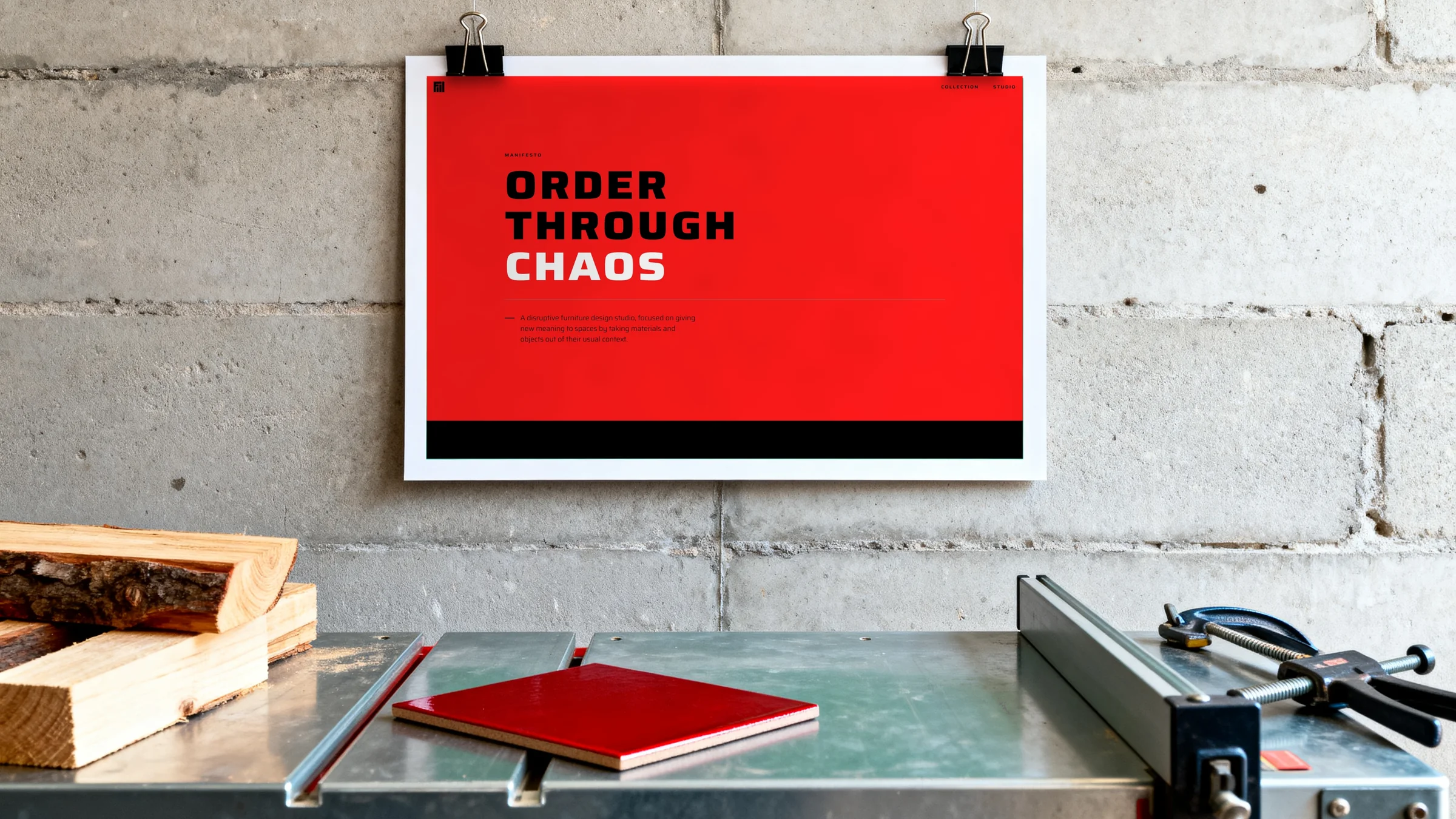
The pictures in this article show the single-line kind in use: one label, a three-word headline and a sentence on what the studio does, set as the first screen of a website. The longer text it came from sits behind it, guiding everything else on the site.
How does a manifesto differ from mission, vision, values and positioning?
These five documents are often confused, and companies sometimes write a manifesto when what they need is a positioning statement, or the other way round. The difference is in who each is for and what each does.
| Document | Question it answers | Main reader | Tone | Typical length |
|---|---|---|---|---|
| Brand manifesto | What do we believe, and what do we stand against? | Customers, future staff, the public | Emotional, declarative | A short page |
| Mission statement | What do we do, for whom, and why? | Staff, partners, investors | Plain, factual | One or two sentences |
| Vision statement | What future are we working towards? | Staff, investors | Aspirational | One sentence |
| Values | How do we behave while we do it? | Staff first | Practical | Three to six short principles |
| Positioning statement | Why should a given buyer choose us over the alternatives? | Internal: marketing and sales | Precise, comparative | A structured paragraph |
The positioning statement is the strategy; the manifesto is that strategy given a voice. Write the positioning first, because a manifesto without one tends to sound bold and mean little. Values describe how you behave; the behaviour part of a manifesto picks the two or three that customers will notice and turns them into promises.
Which mistakes weaken a manifesto?
Most weak manifestos fail in the same few ways, and all of them can be caught in a careful read.
- No tension. The text opens with “we believe” and never says what it believes against. Without an opponent, the belief has no edge.
- Beliefs nobody would reject. Honesty, quality, passion and innovation are table stakes. If a competitor would sign the sentence, rewrite it.
- Promises you cannot keep. A manifesto is public. A claim about your products or your impact that you cannot back is a risk to trust and, in the EU, can fall under the rules on misleading commercial practices in the Unfair Commercial Practices Directive. Say what you do, not what you hope.
- Written by committee. Every department adds a line until the text says everything and therefore nothing. One writer drafts; the group reviews against the five parts.
- The wrong voice. A manifesto in a register the brand never uses elsewhere sounds borrowed. It should set the voice, not escape from it.
- Too long. Past a page the reader stops feeling and starts skimming. Cut until each sentence carries weight.
How do you use your manifesto once it is written?
A manifesto that lives only in a slide deck has not been used. Its real job is to steer decisions, so put it where decisions are made.
- Brief the identity with it. Give the manifesto to the designers before the first sketch. The tension and the belief suggest the visual temperament: quiet or loud, precise or loose. Our article on brand image vs brand identity explains how those choices reach the public.
- Open the website with its line. The line to carry often becomes the first words of the home page or an About page, with the full text a scroll away.
- Use it to write the tone of voice. Each part becomes a writing rule: how you describe the problem, how direct you are, which words you never use.
- Hand it to new staff on day one. It explains the company faster than a handbook.
- Test decisions against it. A new product, a partnership or a campaign either fits the belief or it does not. That test is the manifesto’s most valuable use.
- Revisit it, rarely. Read it once a year. If the company has changed, rewrite it; if it has not, leave it alone.
If you are choosing a studio to help with the identity that follows, our guide on how to choose a graphic design agency sets out what to ask before you commit.
Questions people ask
How long should a brand manifesto be?
Most work best between a hundred and four hundred words, short enough to read aloud in under two minutes. Longer texts lose force, because the reader moves from feeling to skimming. Many brands also keep a single-line version, a headline and one sentence, for places like the first screen of a website, where space is short.
Who should write the brand manifesto?
One writer should draft it, ideally someone who has heard the founders, the team and the customers during research. A group then reviews the draft against the five parts: tension, belief, behaviour, people and line. Writing by committee tends to add a line for every department, which blurs the belief until it says nothing.
Is a brand manifesto the same as a mission statement?
No. A mission statement says plainly what the company does, for whom and why, mostly for staff and partners. A brand manifesto declares a belief and what the brand stands against, in an emotional voice meant for customers and the public. Many companies keep both: the mission for clarity, the manifesto for conviction and voice.
Where can I find good brand manifesto examples?
Look less for famous texts to copy and more for the kind that suits you: rebel, craft, community, single-line or founding letter. Read the About pages and first screens of brands you admire and ask which of the five parts each one leans on. Then write your own from your own tension.
When should a company write its manifesto?
The best moment is after research and positioning, and before the visual identity is designed. At that point the strategy is settled, and the manifesto can turn it into a voice the designers draw from. Writing it later works too, but the identity may then need adjusting to match what the text says.
A good manifesto is short, specific and true, and it is easiest to write when the positioning beneath it is already clear. If you want help finding the tension, the belief and the line, and then turning them into an identity and a website, see how we approach branding projects, or talk to us about your brand.
Further reading: Social media brand guidelines: what to include, How much does branding cost in 2027? What you pay for, Brand positioning: a definition and a worked method.