Micro influencer cost is the sum of two different payments: the fee each creator earns for making and publishing content, and the fee an agency or platform charges for finding, briefing, contracting and reporting on those creators. The creator’s share depends on audience fit, the work asked of them and the rights you want; the agency’s share depends on how much of the campaign it runs for you. This guide covers both sides, the cost lines in a quote, micro and macro creators compared, contracts, the EU disclosure rules and how to read a proposal.
Last updated: 21 October 2026.
Why does this guide give no price list?
Any figure printed here would mislead most readers. Two creators with the same follower count can differ several times over in what they charge, because one films, edits and scripts a short video for a demanding audience while the other reposts a product photo. Rates also move with the platform, the season, the country and the rights attached. So this guide gives the structure of the cost, the relative weight of each line and the questions that move it, which is what you need to set a budget and compare proposals.
At Odduel, a creative and technology agency in Barcelona and São Paulo, we plan and run social media and influencer marketing with a quote fixed after a short brief. AI carries part of the repetitive work in our campaigns (first-pass creator shortlists from public data, brief drafts, caption variants, translation drafts, reporting tables), which keeps the management line lean. Strategy, creator selection, the creative idea, the conversation with each creator and the final review stay human work, and that is where the budget goes.
In short: you pay creators for content, reach and rights, and you pay an agency for the work around them. The creator payments are usually the largest share of a well-run campaign. The agency fee should be visible as its own line, never hidden inside creator rates. Usage rights, exclusivity and paid amplification are the lines buyers most often forget.
What is a micro influencer?
A micro influencer is a creator with a modest, focused audience, usually a few thousand to a few tens of thousands of followers, who posts about a defined subject such as food, fitness, design, parenting or a local scene. There is no official threshold: platforms and agencies draw the lines differently, so ask any partner which tiers they use.
What sets micro creators apart is not the number but the relationship. Their followers often chose them for one subject and read the comments. A recommendation from a micro creator tends to look like advice from someone who knows the field, which is why brands use several of them instead of one large account.
The usual tiers, roughly:
- Nano creators: the smallest audiences, often friends, neighbours and a close circle of fans.
- Micro creators: a focused audience on one subject, large enough to plan a campaign around.
- Mid-tier creators: a broader audience, more professional production, often with a manager.
- Macro creators and celebrities: large, mixed audiences, agents, rate cards and longer negotiations.
How is micro influencer cost made up?
The total has two halves, and a good proposal keeps them apart.
The creator payments. Each creator is paid for an agreed piece of work: a number of posts, stories or short videos, published on agreed dates, with agreed rights. Payment may be a fixed fee, products or a service in kind, a commission on sales through a code or link, or a mix. Many micro creators accept a smaller fee plus product, but treating product alone as payment is fair only when the creator agrees and the work is light.
The agency or platform fee. This pays for strategy, finding and vetting creators, outreach, negotiation, briefs, contracts, content review, publishing schedule, payments to creators, and reporting. Agencies charge it in one of three ways: a fixed fee for the campaign, a monthly retainer for an always-on programme, or a percentage of the creator budget. Our article on agency pricing models explains when each one serves the client.
A third half sometimes appears: paid amplification. When you pay the platform to show a creator’s post to more people, that media budget is separate again, and it needs the creator’s permission in the contract.
Which cost lines should a quote show?
A complete quote for a micro influencer campaign names each of these lines, even when some are small or zero.
| Cost line | What it pays for | Relative weight |
|---|---|---|
| Strategy and brief | Goals, audience, message, platforms, measures of success | A small share, done once |
| Creator search and vetting | Shortlist, audience checks, past brand work, values fit | Grows with the number of creators |
| Outreach and negotiation | First contact, terms, rates, dates, rights | Grows with the number of creators |
| Creator fees | Content, publishing and agreed deliverables | Usually the largest share |
| Product and shipping | Samples, kits, returns, customs outside the EU | Varies with the product |
| Usage rights and exclusivity | Reusing content in adverts or on your site; no rival brands for a period | Can rival the fee itself |
| Content review and compliance | Checking claims, disclosure labels and brand rules before publishing | A modest share |
| Paid amplification | Platform media spend behind creator posts | Separate budget, optional |
| Reporting | Collecting results, reading them, recommendations | A small share |
| Agency management | Coordination, schedule, payments to creators, problem solving | Fixed, retainer or percentage |
If a line is missing, ask whether it is included elsewhere, excluded, or simply forgotten. Rights and exclusivity are the lines most often left out, and they cause the most disputes later.
What drives the creator’s fee?
Follower count is the starting point buyers expect, but it is rarely what decides the fee. In our experience these factors move it more:
- The work asked. A single photo post is not a scripted, filmed and edited short video. Production time is the biggest driver of a creator’s rate.
- The number of deliverables. Posts, stories, short videos, a live session, a blog entry: each one is priced, and bundles often cost less per piece.
- Usage rights. Content that stays on the creator’s account costs less than content you may reuse in adverts, on your website or in shops, for a longer period or in more countries.
- Exclusivity. Asking a creator not to work with competing brands for weeks or months takes income away from them, so it is paid for.
- Audience quality. Engagement that looks genuine, followers in your market, and an audience that matches your buyer all raise what a creator can fairly ask.
- Subject and expertise. Creators in specialised fields (health, finance, professional tools, high-end design) tend to charge more, because their recommendation carries more weight and their audience is harder to reach.
- Timing. Busy seasons such as the run-up to the end-of-year holidays raise demand, and short deadlines raise prices.
- Approval rounds. Every round of brand changes takes the creator’s time. Agree the number of rounds in advance.
Micro vs macro creators: which costs less for the result?
A macro creator costs more per post, but the right comparison is cost per result, not cost per post. The table below compares the two in the terms a buyer cares about.
| Question | Micro creators | Macro creators |
|---|---|---|
| Fee per post | A fraction of a macro fee | The highest fees, often through an agent |
| Audience | Focused on one subject, often one market | Broad, mixed, often several countries |
| Trust and engagement | Personal, closer to a recommendation | Wide awareness, less personal |
| Number needed | Several to many for real reach | One or a few |
| Management effort | High: many contracts, briefs and payments | Lower count, longer negotiation |
| Creative control | Flexible, more room for the creator’s voice | Stricter terms, set formats |
| Risk | Spread across many creators | Concentrated in one name |
| Best for | Trial, consideration, local or niche markets, content volume | Launches, mass awareness, a headline moment |
The trade-off is plain: micro creators make the creator budget work closer to the buyer, but the work around them grows with every name added. That is why management is a larger share of the total in a micro campaign than in a campaign with one famous face, and why a partner with a clear process saves money even when its fee is visible.
What does an agency charge for, and when is it worth it?
An agency earns its fee where your own time would cost more or produce less. The tasks below are where that is usually true.
- Finding the right creators. Checking audiences for fit and for signs of bought followers, reading past brand work, and judging tone takes hours per creator.
- Briefs that leave room. A good brief says what must be said, what must never be said, and then trusts the creator’s voice. Over-scripted content looks like an advert and performs like one.
- Contracts and payments. Many small contracts, invoices and payments across countries, with VAT handled correctly, are work in themselves.
- Compliance. Disclosure labels, claims about products and regulated subjects need checking before anything goes live.
- Reading the results. Separating what the campaign did from what would have happened anyway, and deciding which creators to keep.
You may not need an agency if you run a handful of creators you already know, in one market, with simple product gifting. You probably do if you want many creators, several countries, paid amplification or content you will reuse in adverts. For the wider picture of channels and budget split, see our digital marketing planning guide.
Fees versus creator payments: how to keep them apart
Ask for the creator budget and the agency fee as separate figures, and for each creator’s fee to be paid in full to the creator. A percentage fee is easy to understand but rewards a larger creator budget rather than a better one; a fixed fee rewards efficiency. Either works when it is written down and you can see what each creator receives.
How do creators like to be paid?
Fairness matters here, and not only for ethics: creators talk to each other, and a brand known for late payments or unclear terms finds the best ones unavailable.
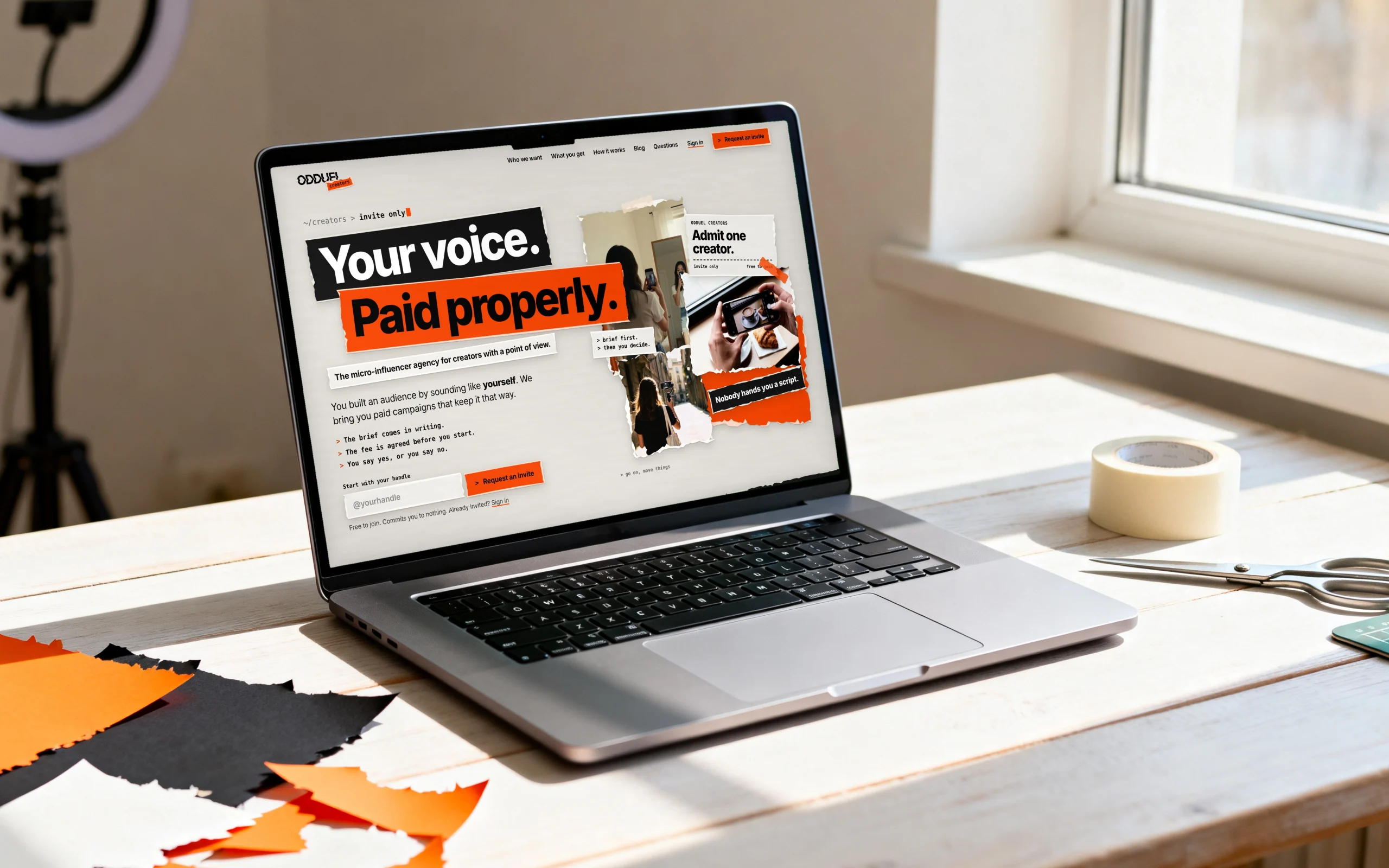
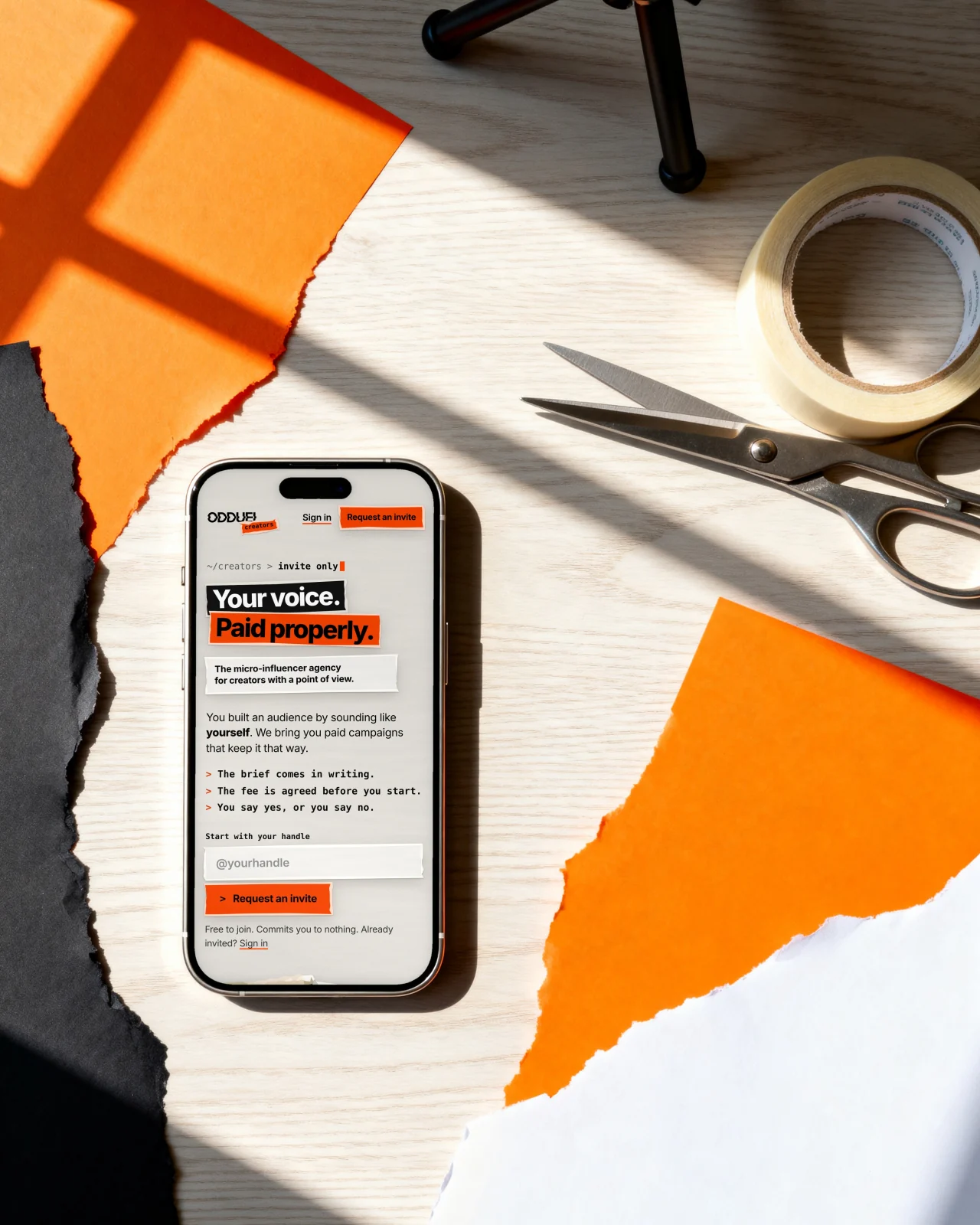
Creators value a written brief before they start, a fee agreed before the work, the freedom to say no to content that does not fit them, and payment on a clear date. At Odduel we built our own invitation-only roster with those terms, described in our call for micro-influencers; the promises on that page are the same ones we make to clients about how their creators will be treated.
In practice:
- Agree the fee, deliverables, dates and rights in writing before anything is shipped or filmed.
- Pay a fixed fee for content, and add commission on sales only as a bonus, not as the whole payment.
- Pay on a stated date after publishing, not on the brand’s approval of results.
- Credit the creator when you reuse their content, unless agreed otherwise.
What goes in a creator contract?
A short, clear contract protects both sides. It should cover:
- Deliverables: the number and type of posts, the platforms, the dates and the time each post stays up.
- Approval: whether you review content before publishing, and how many rounds of changes are included.
- Fee and payment terms: amount, currency, what is paid in kind, invoicing, payment date, VAT position.
- Usage rights: where you may reuse the content (adverts, website, shop, email), for how long and in which countries.
- Exclusivity: which competing brands are excluded and for how long, if at all.
- Disclosure: the creator’s duty to label the content as advertising, and the label you expect.
- Claims: what the creator may and may not say about the product, especially for health, cosmetics, food or finance.
- Personal data: who handles audience data and how, under the GDPR, if the campaign collects any (competitions, sign-ups).
- Cancellation: what happens if either side withdraws, or if the content has to be removed.
Have a lawyer check your template once; the rules on consumer protection and on regulated products differ between EU countries.
What do EU rules say about disclosing paid posts?
Across the EU, advertising has to be recognisable as advertising. The Unfair Commercial Practices Directive treats hiding the commercial purpose of content as a misleading practice, and among its banned practices lists paying for editorial content without making clear that it is paid for. That principle applies to creators: a post the brand paid for, in money or in kind, must say so clearly.
What this means in practice:
- The label must be clear and visible at once, in the language of the audience, not hidden among hashtags or behind “more”.
- Using the platform’s own paid partnership tool helps, and an obvious word such as “advert” or its local equivalent is safest.
- Both the brand and the creator carry responsibility, so the brief should state the label to use.
- National authorities and self-regulatory bodies add their own guidance, and some countries are stricter than others. Check the rules of each market you run in.
Product claims follow their own rules too: food, cosmetics, medicines, alcohol and financial products are regulated, and a creator cannot say what the brand itself is not allowed to say.
How do you set a micro influencer budget?
Start from the goal and work backwards, rather than from a number of creators.
- Name the goal. Awareness in a new market, sales of one product, content for your own channels, or sign-ups. Each one changes the mix.
- Choose the measure. Reach and views, saves and shares, clicks, code redemptions or sales. Agree it before you choose creators.
- Decide the content and rights. If you want to reuse the videos in adverts, budget for rights from the start; buying them later costs more.
- Size the creator list. Enough creators to test, with room to keep the ones that work. A first wave and a second wave cost less than one big launch that cannot learn.
- Add the management line. Fixed, retainer or percentage, written as its own figure.
- Keep a reserve for amplification. Boosting the posts that already work is often the best use of extra budget.
- Plan the review. A short report at the end of each wave decides who continues.
A fixed quote follows a short brief: goal, markets, product, dates and the content you want to keep.
How do you read an influencer marketing proposal?
When proposals arrive, compare them on the same questions:
- Are the creator payments and the agency fee shown separately?
- Is each creator named, or at least described, with the reason for choosing them?
- Are usage rights and exclusivity priced, with periods and countries?
- How many deliverables does each creator make, and how many approval rounds are included?
- Who checks disclosure and product claims before publishing?
- What will the report measure, and when will you receive it?
- What happens if a creator withdraws or a post underperforms?
A proposal that answers all seven is easier to compare and much less likely to bring surprises.
Questions people ask
How much does a micro influencer cost per post?
There is no fixed rate. The fee depends on the work involved, the platform, the creator’s subject and audience, the rights you want and any exclusivity. A simple photo post costs a fraction of a scripted, filmed and edited video. Ask creators for their rates with the brief in hand, so they price the actual work rather than a guess.
Is it cheaper to work with micro influencers than with one large creator?
Each micro creator costs much less per post, but you need several of them, and the work of finding, briefing, contracting and paying them grows with every name. The total can be similar; what changes is the result. Micro creators usually bring a closer, more trusted audience, and the risk is spread across many people.
Can I pay micro influencers with free products?
Sometimes, if the creator agrees and the work asked is light. Many creators accept product plus a smaller fee. Paying only in product for real production work is rarely fair and often leads to weaker content. Gifted products still count as payment for disclosure, so the post must still be labelled clearly as advertising.
What percentage does an influencer agency take?
It varies. Some agencies charge a percentage of the creator budget, others a fixed campaign fee or a monthly retainer. What matters most is that the fee is shown as its own line, separate from what each creator receives. A fixed fee rewards an efficient campaign; a percentage grows with spending, whatever the result.
Do influencer posts have to be labelled as ads in the EU?
Yes. EU consumer protection law requires commercial content to be recognisable as such, and paying for content without making that clear is a banned practice. A paid or gifted post must carry a clear, immediate label in the audience’s language. National rules add detail, so check each market you run a campaign in.
Who owns the content a creator makes for my brand?
By default the creator usually keeps ownership, and you get the rights the contract grants. If you want to reuse the content in adverts, on your website or in shops, the contract must say where, for how long and in which countries. Those rights are priced on top of the creator’s fee.
If you are planning a creator campaign, start with the goal, the markets and the content you want to keep, and we will turn that into a fixed quote with the creator budget and our fee shown apart. See how we plan and run social media and influencer marketing, or talk to us about your campaign.
Further reading: Corporate video production cost: what drives the price.