AI in web design and development changes three things for the client: how long a project takes, where the budget goes, and how much of the result is decided by people rather than produced by hand. At Odduel, AI carries the repetitive production (design-system components, front-end code, first drafts, image preparation, testing, first-pass translations), so a project costs less than it did two years ago and is delivered in weeks rather than months. Strategy, the concept, art direction, the brand’s voice and the final craft stay human work, and that is where the budget goes. This article explains what AI actually does inside a project today, where it saves time, where it does not replace people, what the client gains, and how to tell an agency that uses AI well from one that hides behind it.
Last updated: 29 October 2026.
What does AI in web design and development do today?
Strip away the marketing and AI in a design and development project is a set of tools that help people produce first versions faster and check work more thoroughly. In a typical website project at Odduel it appears in five places:
- Research: summarising interviews and the content of the existing site, reading public pages in the client’s market, clustering search data.
- Writing: first drafts of page copy, meta descriptions, alt text and translations, every line reviewed and rewritten by a person.
- Design production: the first draft of a component library, image cuts for every screen size, variations of a layout to compare before one is refined by hand.
- Code: the front-end code of a page type, repetitive functions, the first-pass markup of a design.
- Quality assurance: test scripts, checks across screen sizes, accessibility and performance reports.
In each case AI produces a starting point or runs a check. A designer or a developer decides what is kept, corrected or discarded. Work that took a week takes a day; work that took a day takes an hour. That is the whole change, and it reaches the quote, as our guide to how much a website costs sets out in figures.
Where does it save time?
The savings are real and they come from removing repetition, not from removing thinking. The parts of a project that benefit most are the ones that repeat.
What to decide first
Before the first screen is designed, two decisions set how much AI can carry in your project. The first is the content plan: a site with hundreds of product descriptions, many service pages or several languages gains far more than a five-page brochure site. The second is the structure: ten service pages that share one template are produced quickly; ten pages each designed differently are not. Settle both with your agency at the start, the way our note on agency onboarding describes.
Projects where AI changes the timeline most:
- Large content volumes: catalogues, service pages, several languages.
- Audit-heavy work: redesigns where an old site must be mapped page by page before anything is rebuilt.
- Component-heavy builds: sites assembled from many similar blocks, which is most sites built on a design system.
- Extensive testing: many templates, devices and states.
What to leave for later
Not every new tool belongs in your project. A chat feature, a personalisation engine or automated content on the live site is a separate decision with its own cost, data questions and maintenance. It should solve a specific problem your visitors have, not be added because it is possible. We treat it as its own piece of work under AI development, scoped after the site, never bundled into the build without a reason.
Where does it not replace people?
Three things remain firmly human, and they are the three that decide whether a site wins.
Judgement. Deciding what a page should say, which audience matters most and what to leave out. AI can list options; it cannot know your business, your clients or your priorities the way you and your agency do.
Taste. The difference between a competent site and a memorable one lies in hundreds of small decisions about type, spacing, rhythm, imagery and motion. AI can generate variations; an art director knows which one is right and why. The same applies to imagery and to the identity itself: our branding work starts with a concept that no tool proposes.
Accountability. Someone must answer for accuracy, accessibility, security, legal compliance and the result. That cannot be delegated to a tool, and it is why every line AI produces for us is read by the person who signs the work off.
This is also why the worry that AI takes creative work away is better framed as a change in what creative people spend their time on: less production, more direction.
What does the client gain?
The main benefit for a client is not only that projects cost less, although in our experience they do. It is that each euro reaches further into the work that counts:
| Time saved on | Time moved to |
|---|---|
| First drafts of copy | Editing, voice and accuracy |
| Boilerplate code | Performance, accessibility, interaction details |
| Manual testing | Fixing what tests find, user testing |
| Image cuts and variations | Art direction and photography |
| Audits and page mapping | Strategy and structure |
For a client this shows up as a launch in weeks, more options at the design stage, and a finished product with fewer rough edges. In our experience a custom marketing site that used to take three to five months now takes four to eight weeks, and a brochure site two to four. The full picture, with the ranges, is in our website development service and in the guide to how a website is developed today.
AI also changes how sites are found. As search results carry AI-written answers, a site must be built with clear structure, extractable answers and consistent facts, which is part of a proper build rather than an extra.
How can you tell an agency uses AI well?
Most agencies now use AI in some form. The difference lies in how openly and carefully. If you are comparing partners, our guide to choosing a digital agency covers the wider questions; these are the ones about AI.
Signs of good practice:
- They can tell you where in the process AI is used and who reviews its output.
- The saving appears in your proposal: a shorter timeline, more scope or a lower price.
- They have clear rules on confidentiality: what client material is and is not put into AI tools.
- Work is checked by qualified people before you see it.
- The result does not look generic: it fits your brand and your audience.
Warning signs:
- Vague claims (“we use AI to supercharge everything”) with no detail.
- Prices that are not lower and timelines that are not shorter.
- Copy that reads like everyone else’s.
- No answer on data handling.
A worked example: a brand site from brief to launch
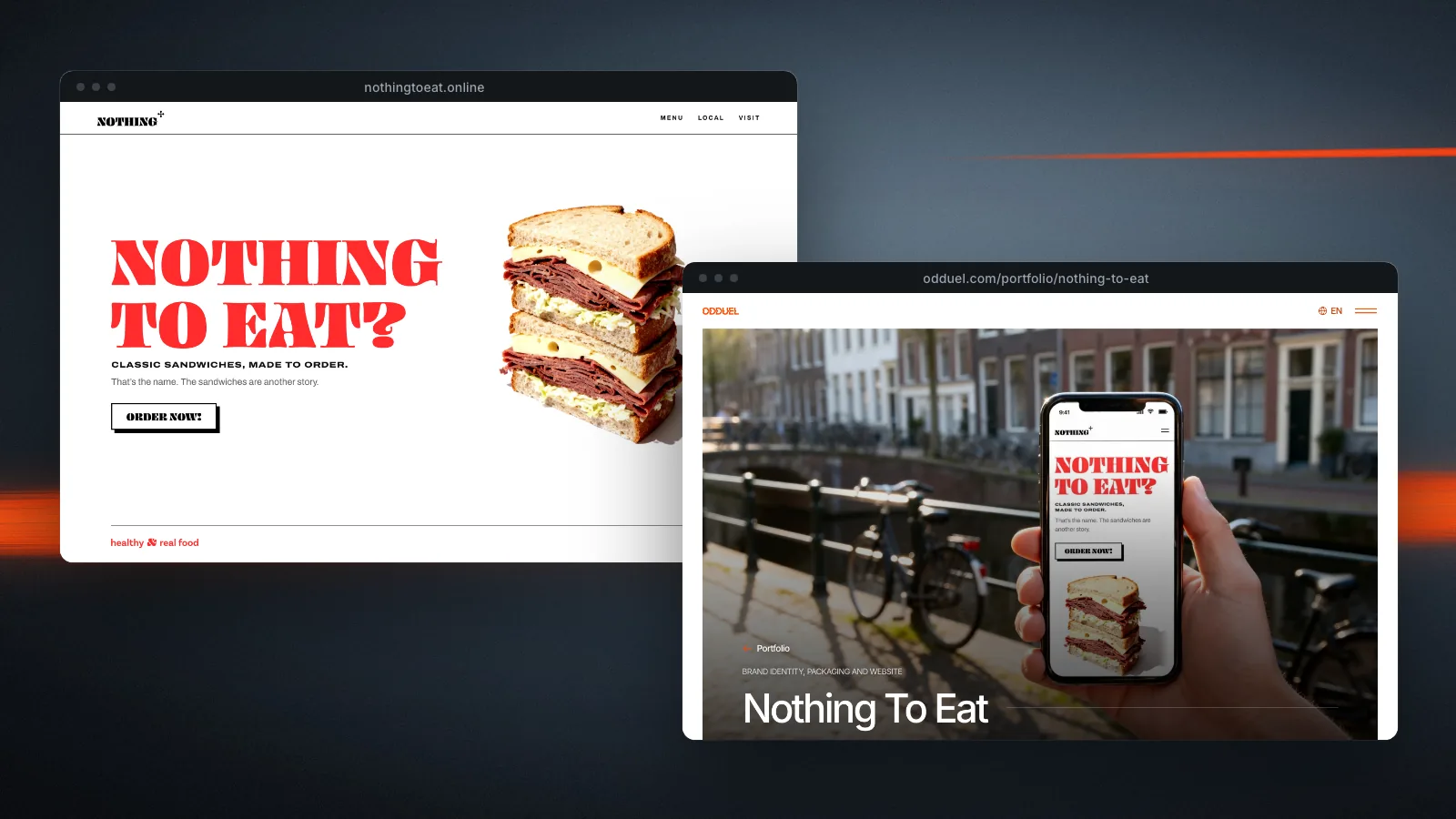
Nothing To Eat is a sandwich brand in Amsterdam for which we made the identity and the website (the case study; the site is at nothingtoeat.online). It shows the division of labour in practice.
- Concept and identity. The name, the voice, the pattern and the logo were decided by people. No tool proposed them; the tools came in afterwards to produce the kit in every size and format.
- Structure and copy. AI drafted the page outline and first-pass copy from the brand voice; a copywriter rewrote it so it sounds like the brand and not like every food brand.
- Design. The designer used AI to produce the image cuts and layout variations quickly, then set the type, the rhythm and the motion by hand.
- Build. The developer used AI for the first draft of the components and the page code, then spent the time saved on performance, accessibility and the small interactions that make the page feel alive.
- Testing. AI generated the checks across devices; the team fixed and re-tested.
- Launch. The site went live in weeks, with the budget spent on the parts a visitor notices.
Nothing in that sequence is unusual. What changes is the proportion of time spent on craft.
What does AI change after launch?
The effect does not stop when a site goes live. It also changes how a site is kept and improved.
- Monitoring: checks for broken links, slow pages, accessibility regressions and security updates run continuously and flag problems early.
- Content upkeep: drafts of updates to ageing pages, new meta descriptions, suggestions for internal links across a growing library.
- Analysis: summaries of analytics and search data that point to the pages worth improving next.
- Small changes: routine requests take minutes rather than hours.
For clients this makes a maintenance and support plan more useful for the same money: more time improving the site, less keeping it running. As in the build, people decide what to change and check the result. From Barcelona and São Paulo, that is how we keep sites improving month after month rather than ageing from the day they launch.
Questions people ask
Does an AI-assisted website cost less?
Yes, in our experience, because the repetitive production takes a fraction of the time it used to. The larger benefit is that the same budget buys more design, content and testing. Ask any agency to show where the saving appears in your quote; if it does not appear, the tools are being used without passing the benefit on.
How long does an AI-assisted project take?
Less than the same scope took two years ago: in our experience a brochure site in two to four weeks and a custom marketing site in four to eight. The schedule still depends on decisions, content and approvals, which remain the longest part of most projects.
Is my material safe if an agency uses AI tools?
It should be, if the agency has rules. Ask which tools are used, whether your material is used to train them, and what is never shared. Confidential documents should only go into tools with contractual protections, and a good agency can show you its policy in writing.
Will the result look generic?
Not if the concept, art direction and voice are decided by people and AI is kept to production. Generic sites come from skipping those decisions, not from the tools. Look at an agency’s recent work: if it has a point of view, the method is working.
Which parts of my project should AI not touch?
Positioning, the concept, the identity, the brand’s voice and the final review. These are the decisions a visitor feels, and they are where a good agency spends the hours it saves elsewhere.
If you want to see how AI could shorten your project without lowering the standard, our AI development service starts with an honest look at where it helps and where it does not. Or talk to us about your project.