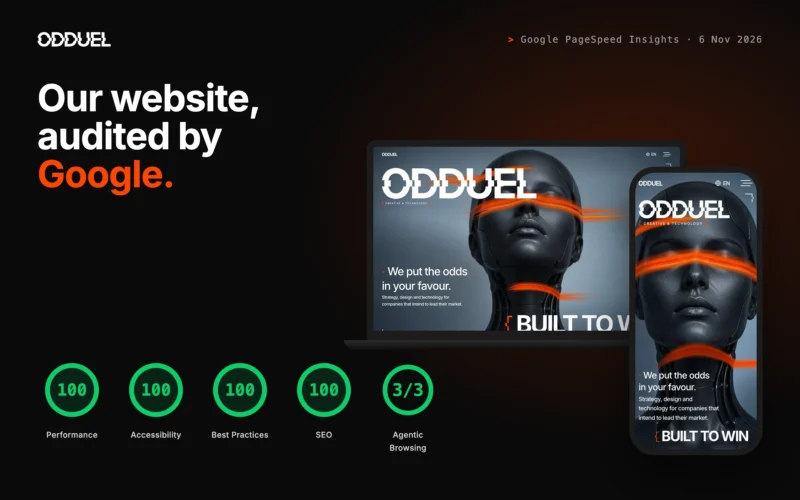
Website development is the process of planning, designing, building and launching a website that serves a business goal, then keeping it fast, secure and up to date. For European companies, a successful website development project starts with a written brief, chooses the platform for the people who will edit the site, and builds in search, accessibility and data protection from the first page template. This guide covers where to start, each phase of the work, the choices that shape cost and quality, the EU rules that apply, how to choose a partner and how to measure whether the site works.
Last updated: 1 November 2026.
What is website development?
Website development is everything that turns a business need into a working website: strategy, content planning, design, front-end and back-end engineering, content entry, testing, launch and care after launch. It is broader than coding and narrower than “digital marketing”: its job is a site that loads quickly, reads clearly, ranks for the right searches and turns visitors into enquiries or sales.
Most business websites fall into a few types:
- Company websites: who you are, what you offer, proof of work and a way to get in touch.
- Lead generation sites: built around forms, bookings and calls, with landing pages for campaigns.
- Content sites: blogs, guides and resources that win search traffic over time.
- Online stores: catalogues, carts and checkouts, a discipline of their own.
- Web applications: portals and dashboards, covered in our application development guide.
At Odduel, a creative and technology agency in Barcelona and São Paulo, our website development service covers the first four. Where an existing site needs a new start rather than a new build, the same process applies with a migration plan added.
In short: write a brief with goals and numbers. Plan the pages and content before the design. Choose a platform your team can edit. Design for phones first and test with real content. Build for speed, accessibility and search from the first template. Launch with analytics and redirects in place, then improve every month.
Where should a company start with website development?
Start with what the website must achieve and for whom, written down before anyone opens a design tool. A brief of two or three pages is enough, and our guide to writing a website brief gives a template.
- Set the goal. Enquiries, bookings, sales, applications or reputation. Pick the one that matters most.
- Describe the audience. Who visits, what they need to know and what makes them act.
- Audit what exists. Current pages, traffic, search rankings, content that performs and content that does not.
- Plan the content. List the pages, who writes them and in which languages. Content is the most frequent cause of delay.
- Name the people who will edit. Their skills decide the platform more than any feature list.
- Agree the constraints. Budget range, launch date, integrations (CRM, booking, payments) and the accessibility level you will meet.
The brief is also what makes two quotes comparable. Without one, suppliers price their own assumptions.
What does website development involve in practice?
Website development involves six phases, each producing something the next one depends on.
Discovery and planning
Discovery turns the brief into a sitemap, a content plan and a technical outline. It includes keyword research for the main pages, a review of competitors’ structure (for analysis, not for copying) and decisions on languages, integrations and hosting.
Content and structure
Structure decides what goes on each page and in what order. Wireframes test the hierarchy with real headings and real text. Clear navigation, including aids such as breadcrumb navigation on deeper sites, helps both visitors and search engines.
Visual design
Design gives the site its identity on screen: layout grid, type, colour, imagery and the behaviour of every component in every state. Typography deserves more attention than it usually gets; our article on web typography explains why it carries most of a site’s tone.
Development
Development builds the templates, the components and the editing experience, connects forms and integrations, and sets up performance, security and search basics: clean addresses, titles and descriptions, structured data, sitemaps and fast loading.

Testing
Testing covers browsers, phones, forms, integrations, accessibility, speed and content. Every page is checked with real content, not placeholder text, because real content breaks layouts that placeholders hide.
Launch and care
Launch moves the site live with redirects from old addresses, analytics with consent, and search engine sitemaps submitted. Care after launch means updates, backups, monitoring and steady improvement.
Which platform should you build on?
The right platform is the one your team can run without calling a developer for every change, at the level of design and performance your brand needs.
| Approach | Best for | Strengths | Trade-offs |
|---|---|---|---|
| Open-source CMS (such as WordPress with a custom theme) | Company, content and lead sites | Familiar editor, large ecosystem, full ownership | Needs updates and security care |
| Hosted website builder | Small sites with simple needs | Quick start, hosting included | Limited design control and portability |
| Headless CMS with a JavaScript front end | Complex sites, apps and content reused across channels | Flexibility and speed at scale | More engineering and higher running effort |
| Hosted e-commerce platform | Online stores | Checkout, payments and stock included | Platform fees and its own limits |
For teams deciding on the front-end layer of a custom build, our comparison of Next.js and React explains what each brings. For most company websites, a well-built CMS theme is the better choice: easier to edit, cheaper to run.
How long does website development take?
A focused company website usually takes a matter of weeks; a large multilingual site with integrations takes a few months. Content and decisions, not code, set the pace in most projects.
Our article on how long it takes to build a website breaks down each phase and the most common delays.
What drives the cost of website development?
The cost of website development depends on the amount of custom work, the content effort and the care needed after launch. We do not publish price ranges because a fair figure follows a brief, but every quote is built from the same lines.
- Number of templates: the distinct page layouts, which matter more than the number of pages.
- Design depth: an adapted design system costs a fraction of a fully custom visual language with motion and illustration.
- Content: copywriting, translation, photography and video often take a larger share than expected.
- Integrations: CRM, booking, payments, search or a product catalogue each add work.
- Languages: each language adds translation, review and search work, plus a correct technical set-up.
- Accessibility and performance targets: a defined level adds design and testing work, and saves rework later.
- Care plan: hosting, updates, backups, monitoring and support every month after launch.
A good quote shows each of these lines, states its assumptions and prices the care plan separately.
Which EU rules apply to a business website?
European rules shape how a website collects data, who can use it and what it must tell visitors.
- Data protection: the General Data Protection Regulation governs every form, analytics tool and newsletter sign-up. Collect only what you need, explain why, and secure it.
- Cookies and tracking: analytics and marketing tags that store or read information on a visitor’s device need consent first, with a real choice to refuse.
- Accessibility: the European Accessibility Act covers many consumer-facing digital services, such as online stores and banking. The technical reference is the W3C’s Web Content Accessibility Guidelines. Our guide to website accessibility explains what to check.
- Legal information: company details, privacy and cookie policies, and for online sales the consumer information each country requires.
Plan these from the first template. A cookie banner added at the end often breaks analytics, and accessibility fixed at the end costs far more than accessibility designed in.
How do you choose a website development partner?
Choose the partner whose questions show they understand your goal, and whose launched sites load fast and read well on a phone.
- Open their sites on your phone. Speed, clarity and ease of contact tell you more than a presentation.
- Ask about content. Who writes, who translates, who enters the pages, and when.
- Ask who edits after launch. You should be able to change text, images and pages yourself.
- Check ownership. Domain, hosting, code and accounts should be yours from day one.
- Ask about search and accessibility. They should describe their process without hesitation.
- Ask about care. Updates, backups and support should be a written plan, not a vague promise.
How do you measure whether a website works?
You measure a website against the goal in the brief, with analytics set up before launch and reviewed every month.
- Conversions: enquiries, bookings, sign-ups or sales, and the rate at which visitors complete them.
- Search visibility: impressions, clicks and positions for your main queries in Google Search Console.
- Speed and stability: Core Web Vitals and uptime.
- Engagement on key pages: whether visitors reach the pages that lead to contact.
- Accessibility and errors: broken links, form errors and accessibility issues found in regular checks.
Numbers tell you what changed; a few conversations with clients tell you why. Use both.
What are the most common website development mistakes?
The same mistakes appear on many projects, and all of them are avoidable:
- Designing with placeholder text and discovering late that real content does not fit.
- Choosing a platform for its features rather than for the people who will edit it.
- Launching a redesign without redirects from old addresses, losing search traffic overnight.
- Leaving accessibility and cookie consent to the last week.
- Treating launch as the end, with no budget for care or improvement.
Questions people ask
What is the difference between web design and website development?
Web design decides how a site looks and how visitors move through it: layout, type, colour and interaction. Website development builds it: templates, the editing system, forms, integrations, speed, security and search set-up. A good project treats them as one process, so that design decisions are tested in code early and nothing is redrawn late.
How long does it take to develop a business website?
A focused company website usually takes a matter of weeks from brief to launch, and a large multilingual site with integrations takes a few months. Content is the most common cause of delay, followed by slow decisions. A written brief and a content plan agreed at the start keep the timeline realistic.
Which platform is best for a company website in Europe?
For most company and content websites, an open-source CMS with a custom theme is the best balance of editing ease, ownership and cost. Hosted builders suit very small sites, and headless set-ups suit complex projects with several channels. Online stores usually run best on a dedicated e-commerce platform.
Does a business website need to meet accessibility rules?
Many do. The European Accessibility Act covers a range of consumer-facing digital services, including e-commerce, and public sector sites have their own rules. Even where no law applies, meeting the Web Content Accessibility Guidelines makes a site easier for everyone to use and is far cheaper to design in than to retrofit.
What should a website development quote include?
A clear quote lists the templates, design depth, content work, integrations, languages, accessibility and performance targets, testing and launch tasks, and prices the care plan after launch separately. It also states assumptions and what is excluded. If two quotes differ widely, compare these lines first: they usually describe different projects.
Write your brief: one page on the goal, the audience and the numbers to move is enough to start. When you want it turned into a plan and a fixed quote, see our website development service or tell us about your website.