
A digital marketing agency in Europe plans, runs and measures the online activity that brings a company customers: search, paid advertising, social media, email, content and the analytics that tie them together. Choosing one well comes down to three things: a clear brief of what you need, evidence that the agency has done similar work, and terms that make results visible every month. This guide explains what such an agency actually does, how to compare candidates across European markets and which questions to ask before you sign.
Last updated: 7 November 2026.
What does a digital marketing agency do?
A digital marketing agency is an outside partner that takes responsibility for some or all of a company’s online demand: being found, being chosen and being remembered. The work splits into three layers.
- Strategy: who the customers are, which channels reach them, what each channel should achieve and how success is measured.
- Execution: search engine optimisation, paid search and social campaigns, organic social content, email programmes, landing pages and the creative that goes into all of them.
- Measurement: tracking set up correctly and with consent, reports that link spend to leads or sales, and regular decisions about what to stop, keep or scale.
Some agencies cover every layer; others are specialists in one channel. Neither is better in itself. A company with a strong in-house marketer may only need paid media expertise, while a founder-led business often needs the whole chain. For businesses that sell locally, local SEO is often the first channel to fix.
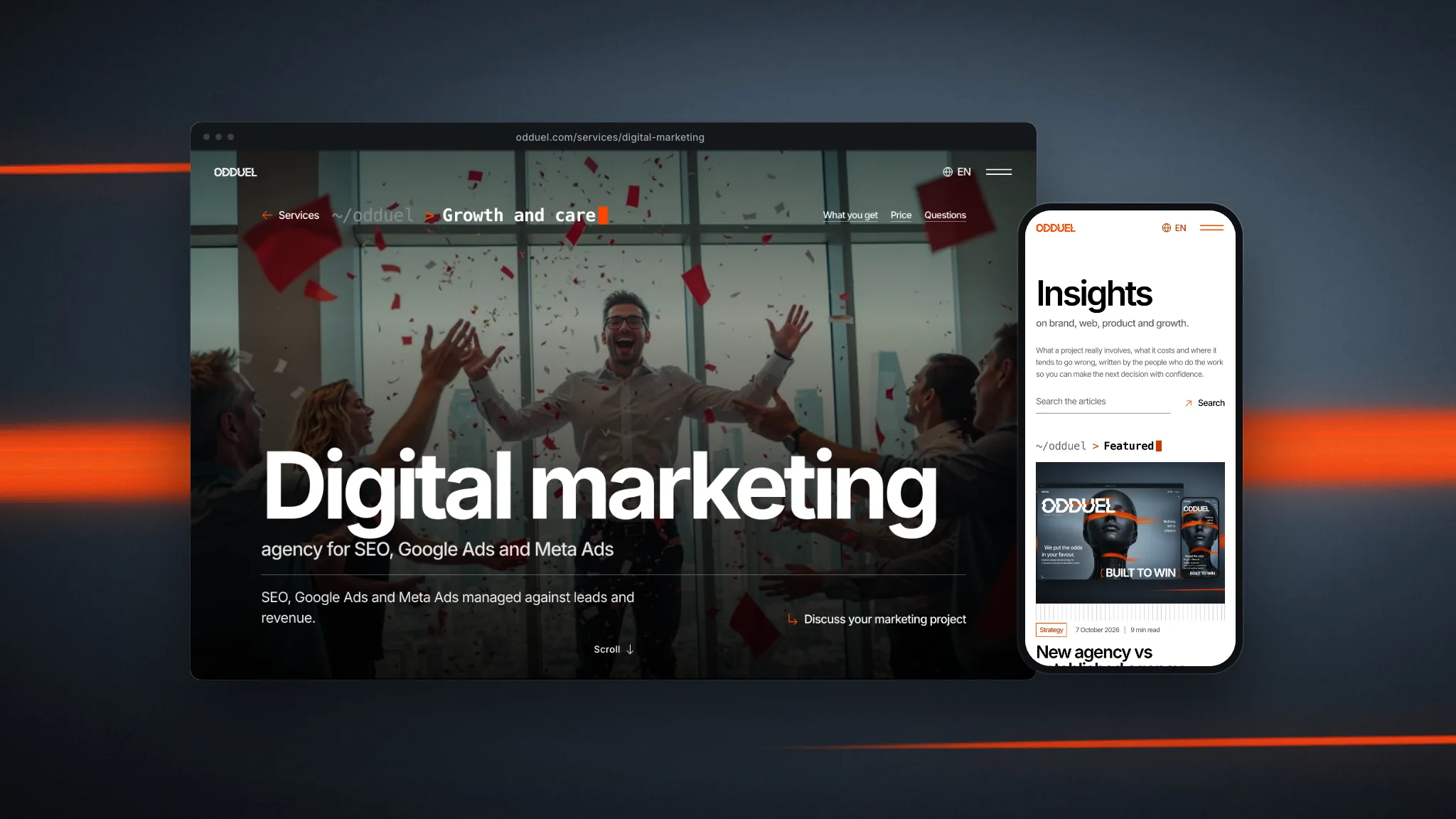
At Odduel, a creative and technology agency in Barcelona and São Paulo, our digital marketing service starts from the website and the tracking, because campaigns can only be judged when the numbers behind them are reliable.
In short: a digital marketing agency turns business goals into channel plans, runs the campaigns and reports on what they return. Choose one by matching its strengths to your channels, checking real examples, meeting the people who will do the work and agreeing reporting and exit terms in writing.
Which services does a digital marketing agency offer?
Service lists look similar from one agency to the next. What differs is depth, and how the services connect. The table sets out the usual services, what each does and the sign that it is being done properly.
| Service | What it covers | Sign of good work |
|---|---|---|
| Search engine optimisation | Technical health, content, internal links, local presence | A plan tied to pages and queries, not a monthly list of tasks |
| Paid search | Campaigns on search engines, keywords, bids, ad copy | Conversion tracking agreed before any budget is spent |
| Paid social | Campaigns on social platforms, audiences, creative testing | Several creative versions tested, results compared fairly |
| Organic social | Calendar, posts, community management | A clear voice and a reason to follow, not volume for its own sake |
| Email and automation | Welcome flows, newsletters, abandoned basket messages | Consent recorded, segments based on behaviour |
| Content | Articles, guides, video, landing pages | Each piece answers a real question from buyers |
| Analytics and reporting | Tracking, dashboards, attribution, monthly review | Reports that end with decisions, not only charts |
For a deeper tour of each channel, our complete guide to digital marketing explains how they fit into one plan.
When does a company need a digital marketing agency?
Hiring an agency makes sense when the work needs more skills than one person can hold, or more hours than your team has. Typical moments are:
- A launch: a new company, product, market or website that needs demand from day one.
- A plateau: growth has stalled and nobody can say which channel is failing.
- A new market: you sell in Spain and want to reach France or Germany, with different search habits, platforms and rules.
- A gap in skills: your team writes well but has never run paid campaigns, or the reverse.
- A rebuild of tracking: consent rules, a new analytics set-up or a move between platforms has left the data unreliable.
An agency is rarely the right answer when the offer itself is unclear. If the product, price or audience is still moving every month, spend on strategy and positioning first; campaigns amplify a message, they do not invent one.
How do you choose a digital marketing agency in Europe?
Choosing a digital marketing agency in Europe has one extra layer compared with a single-country search: markets differ in language, platforms, search behaviour and regulation. The steps below keep the process short and fair.
- Write a one-page brief. Goals for the next twelve months, the markets you sell in, channels already used, what has worked, what has not, and who on your side will own the relationship.
- Draw up a short list of three to five agencies. Look for relevant examples, not the biggest names. An agency that has run campaigns in your sector or in your target markets will learn faster.
- Ask each one for a response to the brief. A short written approach, the team who would work on it, how they would measure progress and how they charge.
- Meet the people who will do the work. The pitch team and the delivery team are not always the same.
- Check references. Speak to one or two current clients about communication, honesty when results were weak and how changes were handled.
- Compare on the same scale. Score each response against the criteria in the next table rather than on the presentation.
| Criterion | What to look for | Warning sign |
|---|---|---|
| Fit with your channels | Real depth in the two or three channels that matter most to you | Every service offered with equal confidence |
| Market knowledge | Experience with the languages and platforms of your markets | Translations treated as an afterthought |
| Measurement | Tracking plan, consent handling, clear definition of a lead or sale | Vanity numbers such as reach without context |
| Transparency | Access to ad accounts and analytics in your own name | Accounts held by the agency |
| Team | Named people, their roles and their time on your account | Vague “dedicated team” with no names |
| Terms | Notice period, ownership of creative and data, handover on exit | Long lock-in with no performance review |
Does the agency need to be in your country?
Not necessarily. What matters is that the people writing your copy and running your campaigns know the market they address. A Spanish company reaching German buyers needs German-language copy written for Germans, local search knowledge and an understanding of how German buyers compare suppliers. Ask who writes and checks each language.
What about rules on data and consent?
Every agency working for European clients must handle personal data under the General Data Protection Regulation. In practice that means a data processing agreement, tracking that waits for consent where consent is required and clear answers about where data is stored. If an agency cannot explain how it handles consent in analytics and advertising, keep looking.
How do digital marketing agencies charge?
Agencies in Europe usually charge in one of four ways: a monthly retainer for a defined scope, a project fee for a fixed piece of work such as a launch campaign, hourly or daily rates for flexible support, or a fee linked to performance. Advertising budgets are normally paid directly to the platforms and kept separate from the agency fee.
Each model shifts risk differently. Retainers give continuity; projects give a clear end; performance fees reward results but can push an agency towards whatever is easiest to count. Our article on digital marketing agency pricing breaks the models down and explains how to read a proposal line by line.
Which questions should you ask before signing?
These questions separate a well-run agency from a polished pitch. Ask them in the meeting and ask for the answers in writing.
- Who exactly will work on our account, and for how many hours a month?
- How will you define and track a lead or a sale, and how long will set-up take?
- Which accounts will be in our name? Ad accounts, analytics, tag managers and social profiles should belong to you.
- What will the monthly report contain, and what decisions will it lead to?
- What happens in the first 90 days? A credible answer names an audit, a tracking fix, a first test and a review date.
- How do you handle a channel that is not working? Look for a willingness to cut spend, not only to add more.
- Who owns the creative, the copy and the data if we part ways, and how is handover done?
- How do you handle consent and data protection across our markets?
- What do you need from us each month? Approvals, product information, access and time.
Answers that are specific, honest about uncertainty and clear about responsibilities are a better guide than any promise of growth.
How do you work well with an agency once it starts?
The first months set the tone. Agree one owner on each side, a monthly review with a written summary, and a shared list of open decisions. Give the agency access to sales data where you can, so campaigns are judged on revenue or qualified leads rather than clicks.
Expect the first weeks to focus on audit and set-up rather than visible campaigns. A good agency will fix tracking and the most important landing pages before scaling spend. If your website is the weak link, that is often where the first effort pays back most; an agency that also builds websites, or works closely with your developers, avoids months of waiting for changes.
Review the relationship formally every quarter: what was planned, what happened, what was learned and what changes next. If an agency cannot show a clear line from activity to outcome after two quarters, revisit the brief together before deciding to switch.
What are the most common mistakes when hiring a digital marketing agency in Europe?
The same mistakes appear across sectors and countries:
- Hiring on price alone. A low retainer often buys very few hours of skilled work.
- Skipping the tracking. Campaigns launched without reliable measurement cannot be improved.
- Letting the agency own the accounts. Changing partner later becomes slow and costly.
- Asking for everything at once. Spread across seven channels, a modest budget achieves little in any of them.
- Changing direction every month. Most channels need several weeks of data before a fair judgement is possible.
Questions people ask
What does a digital marketing agency do?
A digital marketing agency plans, runs and measures a company’s online marketing. That usually includes search engine optimisation, paid search and social advertising, organic social media, email, content and analytics. The best agencies connect these channels to one goal, report on leads or sales rather than clicks and recommend what to change each month.
How do you choose a digital marketing agency in Europe?
Write a one-page brief, short-list three to five agencies with relevant examples, and ask each for a written approach. Meet the people who will do the work, check references and compare responses on the same criteria: channel depth, market knowledge, measurement, transparency, named team members and fair exit terms.
Which questions should you ask a digital marketing agency before signing?
Ask who will work on your account and for how long, how leads and sales will be tracked, which accounts will be in your name, what the monthly report contains, what happens in the first 90 days, who owns creative and data on exit and how consent is handled across your markets.
Is a specialist agency better than a full-service one?
Neither is better in itself. A specialist suits a company with in-house marketing that needs depth in one channel, such as paid social. A full-service agency suits a company that needs strategy, creative, website changes and campaigns to move together. Decide based on which skills your own team already has.
How long before a digital marketing agency shows results?
Paid campaigns can produce first data within weeks, though tuning takes longer. Search engine optimisation and content usually need several months before rankings and traffic move clearly. Expect the first weeks to go on audit and tracking; ask for a written 90-day plan with a review date before judging the partnership.
Start with your brief: goals, markets, channels and the one person who will own the relationship. If you would like a partner that connects strategy, creative, website and campaigns, read more about our digital marketing service or tell us about your plans.